Document Generators
Injury & Compensation
Fees & Support
Deadlines & Filing

Workers' compensation provides benefits to eligible employees who suffer work-related injuries or occupational illnesses. Learn who qualifies, what injuries may be covered, what benefits may be available, and what steps to take after a workplace injury. Because workers' compensation laws vary by state, eligibility, deadlines, and claim procedures depend on the applicable jurisdiction.
A workplace injury can create more than physical difficulties. Medical expenses, time away from work, reduced income, and uncertainty about returning to the job can place significant financial pressure on an injured worker and their family. Workers' compensation is designed to provide benefits to eligible employees who suffer work-related injuries or occupational illnesses.
In the United States, workers' compensation generally operates through state laws for employees of private companies and state or local government agencies. Each state has its own rules governing coverage, eligibility, benefits, reporting requirements, and deadlines. Certain groups of workers, including federal employees and some maritime and other workers, may instead be covered under federal workers' compensation programs.
Understanding what workers' compensation covers and who may qualify is important after a workplace accident or work-related illness. This guide explains how workers' compensation works, which employees may be covered, what types of injuries can qualify, what benefits may be available, and what workers should do after a workplace injury.
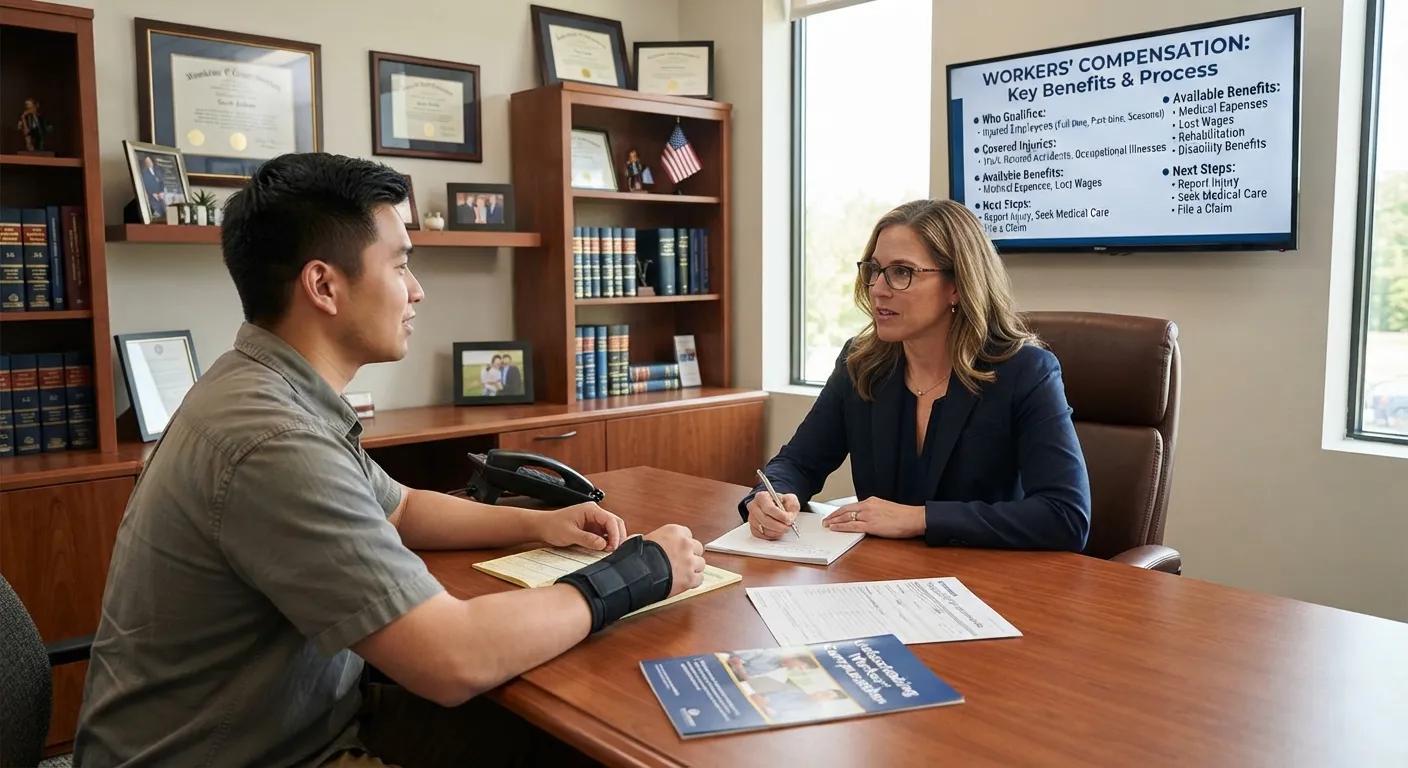
Workers' compensation is a system that provides benefits to eligible workers who are injured or become ill because of their employment. Depending on the applicable law and circumstances, benefits may include medical treatment, wage replacement, vocational rehabilitation, and other forms of assistance.
Workers' compensation generally operates differently from an ordinary personal injury claim. In many circumstances, an injured employee can seek workers' compensation benefits without having to establish that the employer was negligent.
The system is also generally intended to provide a structured process for addressing workplace injuries while establishing rules concerning employer and employee rights and responsibilities.
However, workers' compensation is not governed by one nationwide system covering every worker in exactly the same way. Private-sector and state or local government workers are generally handled through state workers' compensation systems, while certain categories of workers fall under federal programs.
Workers' compensation generally begins when an employee suffers a work-related injury or develops an occupational illness.
The employee typically needs to report the injury to the employer and follow the applicable claims procedure. Depending on state law, the employer may then report the injury to its workers' compensation insurer or the appropriate state agency.
If the claim is accepted, the worker may receive benefits provided under the applicable workers' compensation law. If the claim is disputed or denied, the employee may have administrative or legal procedures available to challenge the decision.
The exact process differs by state. Workers should therefore check the requirements that apply where they work rather than relying on another state's rules.
Eligibility depends on the applicable workers' compensation law, but employees are generally the primary group covered by workers' compensation systems.
The U.S. Department of Labor explains that workers' compensation laws vary by state and that, as a general rule, coverage applies broadly to employees, although state-specific exceptions and requirements exist.
Whether a particular worker qualifies can depend on several factors, including:
Because the rules differ between jurisdictions, simply being injured while performing work does not provide enough information to determine eligibility in every case.
Full-time employees are commonly covered by workers' compensation when their employer and employment relationship fall within the applicable state system.
A workplace injury may qualify even if the employee has worked for the employer for a relatively short period. However, individual state laws can contain specific requirements or exclusions.
Employees should also understand that workers' compensation eligibility is separate from questions about whether they are entitled to other workplace benefits, such as paid leave, disability-related accommodations, or unpaid protected leave.
Several employment laws can potentially apply to the same workplace injury or medical condition, depending on the circumstances.
Part-time employees may qualify for workers' compensation in many circumstances.
Coverage is not necessarily limited to employees who work a particular number of hours each week. However, state laws can establish different rules regarding covered employment, employer requirements, and exclusions.
A part-time worker who suffers an injury while performing job duties should not automatically assume that they are excluded simply because they work fewer hours than full-time employees.
The applicable state workers' compensation agency can provide information about the coverage rules for a particular employment situation.
Temporary and seasonal workers may also be eligible for workers' compensation depending on the applicable law and employment arrangement.
The important issue is not necessarily whether someone works year-round. Instead, the legal relationship between the worker and employer, the nature of the work, and the relevant state requirements can affect coverage.
Workers hired through staffing agencies can present additional questions because more than one business may be involved in the employment relationship. Determining which entity has workers' compensation responsibilities may require examining the applicable law and employment arrangement.
Independent contractors generally are treated differently from employees under workers' compensation laws, but the classification question can be more complicated than simply looking at what a contract or employer calls the worker.
The U.S. Department of Labor notes that misclassification can deprive workers of benefits and protections, including workers' compensation that may otherwise be available to employees.
A worker who receives a Form 1099, operates through an LLC, or is described by an employer as an independent contractor is not necessarily conclusively classified as an independent contractor for every legal purpose.
Worker classification depends on the applicable law and the actual circumstances of the working relationship. The relevant tests can differ between laws, so a classification under one federal or state law does not automatically answer every workers' compensation question.
Workers' compensation can cover a wide range of work-related injuries, although the specific requirements vary by state.
Potential examples include:
The key issue is generally whether the injury or illness meets the applicable legal definition of work-relatedness.
An injury does not necessarily need to happen at the employer's physical workplace. Depending on the circumstances and state law, injuries occurring while performing work duties elsewhere may potentially qualify.
Workers' compensation is not limited to sudden accidents.
Occupational diseases and illnesses can also fall within workers' compensation systems when the applicable requirements are satisfied. The U.S. Department of Labor identifies occupational disease as part of the types of work-related conditions addressed by certain workers' compensation programs.
Examples can include illnesses resulting from repeated workplace exposure or conditions that develop over time.
These claims can sometimes be more complicated than claims involving a clearly documented accident because the worker may need to establish the connection between the employment and the medical condition.
Some repetitive-motion or cumulative injuries may qualify for workers' compensation.
Unlike a workplace accident that happens at a specific time, repetitive injuries can develop gradually. Examples can include certain conditions affecting the hands, wrists, shoulders, knees, or back.
Whether a particular repetitive injury qualifies depends on the applicable state law and medical and factual evidence connecting the condition to employment.
Workers who gradually develop symptoms should not assume that workers' compensation is unavailable simply because there was no single accident.
Not necessarily.
The important question is generally whether the injury is sufficiently connected to employment under the applicable workers' compensation law.
An employee injured while performing assigned duties away from the employer's usual workplace may potentially qualify. For example, an employee traveling for a work assignment or performing duties at a customer location could raise different workers' compensation questions from someone injured during a purely personal activity.
Travel to and from work can also be treated differently from travel performed as part of the employee's job. Because these rules vary, the specific circumstances of the accident matter.

Workers' compensation benefits vary by state and the nature of the injury. The U.S. Department of Labor identifies several types of benefits provided through workers' compensation programs, including wage replacement, medical treatment, vocational rehabilitation, and other benefits.
Workers' compensation may cover medical treatment associated with a compensable workplace injury or occupational illness.
Depending on state rules and the circumstances, medical benefits can involve treatment from doctors, hospitals, rehabilitation providers, or other healthcare professionals.
Workers should follow the applicable rules concerning medical providers and authorization because states may impose different requirements.
An injured employee may be unable to work temporarily or may have restrictions that prevent them from earning their previous wages.
Workers' compensation systems can provide wage-replacement benefits for eligible employees who meet the applicable requirements.
The amount and duration of wage replacement vary by jurisdiction and the type and severity of the injury.
Some workers may qualify for benefits associated with permanent impairment or disability resulting from a workplace injury.
The rules for determining permanent disability can be complicated. They may involve medical assessments, statutory formulas, impairment ratings, and other factors established by state law.
Not every workplace injury results in permanent disability benefits.
Some workers' compensation systems provide vocational rehabilitation or related services when an injured worker cannot return to their previous employment.
These services can potentially assist an eligible worker with developing skills, finding suitable employment, or returning to work, depending on the applicable program.
The availability and scope of vocational rehabilitation vary by jurisdiction.
Workers' compensation generally differs from a traditional negligence-based personal injury claim because an employee may be entitled to benefits without proving that the employer caused the accident.
However, this does not mean that every injury is covered regardless of how it happened.
Workers' compensation laws can contain exclusions and limitations involving issues such as intentional self-injury, intoxication, misconduct, or activities outside the scope of employment.
The exact rules depend on the state and circumstances. An employee should therefore avoid assuming that fault automatically determines eligibility one way or the other.
An employer or workers' compensation insurer may dispute whether an injury arose from employment.
For example, a dispute might concern:
A disputed claim does not necessarily mean that the employee has no legal rights. State workers' compensation systems generally provide procedures for resolving disagreements about claims.
Employees should keep copies of relevant medical records, accident reports, communications, and other documents that may help establish what happened.
Taking practical steps after an accident can help preserve information and avoid preventable problems.
Notify your employer as soon as reasonably possible and follow the reporting requirements that apply in your state.
Workers' compensation laws can impose deadlines for reporting injuries, and failing to report an injury within the required period can affect a claim.
Get appropriate medical attention for the injury or illness.
Medical records can also provide important documentation concerning the nature of the condition, treatment received, work restrictions, and potential connection to employment.
Write down the date, time, location, circumstances, and people involved in the accident.
If the condition developed gradually, record when symptoms began and how they relate to your work activities.
Preserve copies of:
Keeping organized records can make it easier to understand the status of a claim.
The process varies by state, but a workers' compensation claim generally involves reviewing the injury, employment relationship, medical evidence, and circumstances surrounding the accident or illness.
The employer or its insurer may accept the claim, request additional information, or dispute liability.
If the claim is denied, the worker may have a right to challenge the decision through the state's workers' compensation system.
Because state agencies administer workers' compensation for private-sector and state or local government workers, the appropriate state workers' compensation authority is generally the place to obtain jurisdiction-specific information.
Workers may have legal protection against retaliation for exercising certain workplace rights, but the precise protection depends on applicable federal or state law.
Workers' compensation retaliation laws are generally separate from the question of whether an employee qualifies for benefits. A worker can therefore have a valid workers' compensation claim and a separate legal issue involving an employer's response to the claim.
Anyone who believes they were disciplined, demoted, terminated, or otherwise treated unlawfully after reporting a workplace injury should review the specific law applicable to their jurisdiction.
Workers' compensation and personal injury claims are different legal systems.
Workers' compensation generally provides benefits to eligible employees for covered workplace injuries without requiring the employee to prove ordinary employer negligence.
A personal injury lawsuit, by contrast, generally involves proving legal liability under applicable tort law.
In some circumstances, an injured employee may also have a potential claim against a third party whose conduct contributed to the injury. Whether such a claim exists depends on the circumstances and applicable law.
An employee should not assume that receiving workers' compensation automatically eliminates every other potential legal remedy.
Federal employees are generally covered through the federal workers' compensation system rather than state workers' compensation programs.
The Department of Labor's Office of Workers' Compensation Programs administers the Federal Employees' Compensation Program. Other federal programs cover certain specific groups, including qualifying maritime workers, coal miners, and certain energy workers.
This distinction is important because the applicable federal statutes and procedures can differ from state workers' compensation systems.
Many workers' compensation claims can proceed through the applicable administrative system, but legal advice may be useful when a claim becomes disputed or unusually complicated.
Consider speaking with a workers' compensation attorney if:
An attorney can explain the applicable state or federal process, deadlines, evidence requirements, and potential legal options.
Workers can unintentionally create problems with their claims by failing to take basic precautions.
Waiting too long to report the injury: Workers' compensation systems can impose reporting deadlines.
Ignoring medical advice: Failing to follow prescribed treatment or work restrictions can complicate the medical record.
Assuming a minor injury will stay minor: Some workplace conditions become more serious over time.
Failing to document the accident: Important details can become difficult to remember later.
Giving inconsistent information: Workers should provide accurate and consistent information about how the injury occurred and how it affects them.
Assuming independent-contractor status automatically excludes coverage: Worker classification can be more complicated than the label used by an employer.
Ignoring a denied claim: A denial may be subject to an appeal or other review procedure, depending on the jurisdiction.

Workers' compensation provides an important system for employees who suffer work-related injuries or occupational illnesses. Depending on the applicable program, eligible workers may receive medical treatment, wage replacement, vocational rehabilitation, and other benefits.
However, there is no single set of eligibility rules that applies identically to every worker in the United States. Private-sector and state or local government employees generally fall under state workers' compensation systems, while certain federal and specialized workers are covered by federal programs.
If you are injured at work, reporting the injury promptly, obtaining appropriate medical care, preserving documentation, and understanding the deadlines that apply to your claim can be important. When eligibility is disputed, benefits are denied, or the injury is serious, obtaining advice from a workers' compensation professional may help you understand the process and available options.
Written by
FranklyFrankly is a legal researcher and content writer at Jurnza, specializing in legal services, legal tools, legal guides, and law-related educational content. Frankly researches topics including business law, family law, immigration law, personal injury law, tax law, employment law, and real estate law to create accurate, easy-to-understand, and up-to-date resources that help readers make informed legal decisions.
