Deadlines & Filing
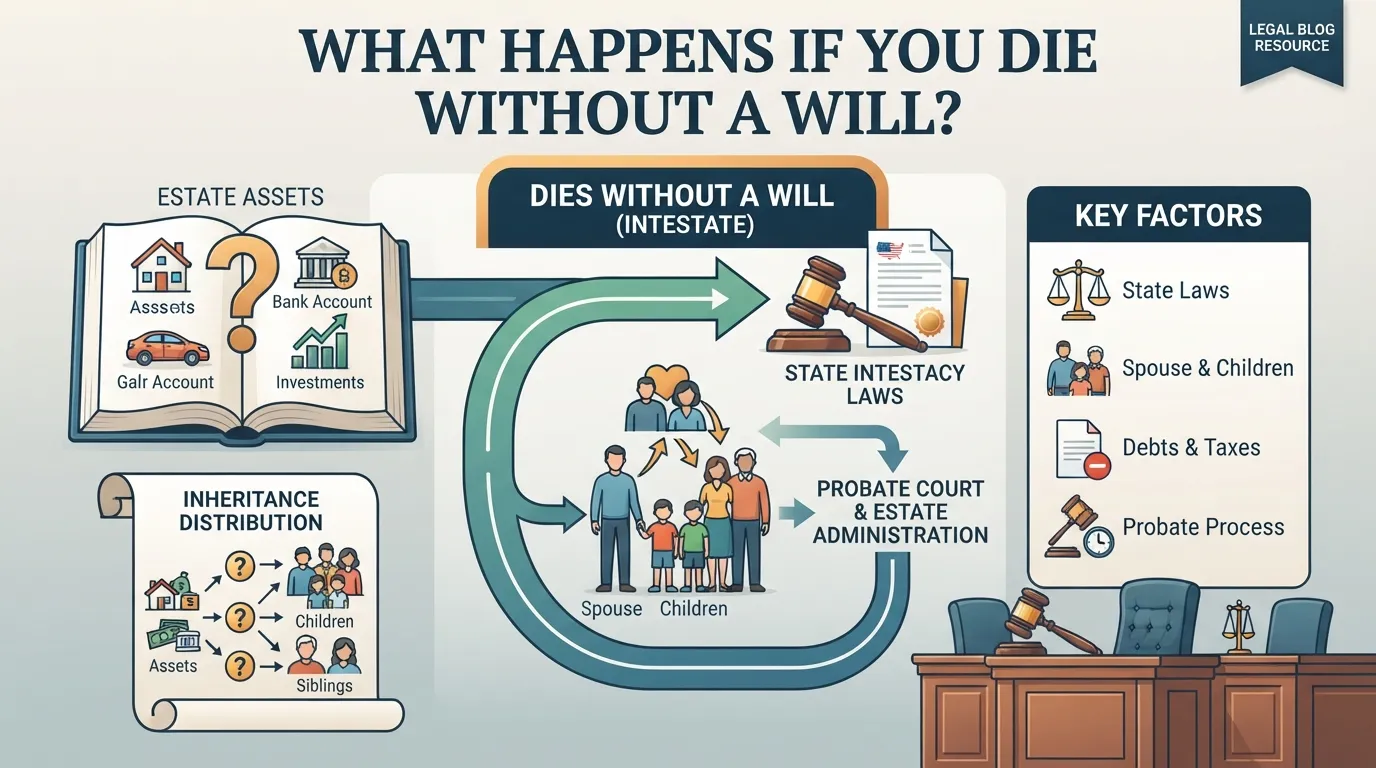
What happens if you die without a will? In the United States, your estate is generally distributed according to state intestacy laws, which determine who may inherit your property and how the estate is handled. The outcome can depend on your spouse, children, other relatives, property ownership, debts, and beneficiary designations. This guide explains intestate inheritance, probate, estate administration, and what families should know when a loved one dies without a will.
If you Die without a will can leave important decisions about your property, finances, and estate to state law rather than to instructions you made yourself. When someone dies without a valid will, they are generally described as having died intestate. In that situation, the state's intestacy laws determine who may inherit the estate and, in many cases, how the estate is administered.
The consequences can depend on where the deceased person lived, what assets they owned, whether they were married, whether they had children, and whether other family members survive them. A surviving spouse may receive some or all of an intestate estate in certain circumstances, while children or other relatives may inherit when there is no surviving spouse or depending on the state's specific rules.
Dying without a will does not necessarily mean that the government automatically takes everything. Instead, the estate generally passes according to applicable intestacy laws after debts, expenses, and other legal obligations are addressed. Understanding how this process works can help families know what to expect when a loved one dies without leaving a will.
Dying without a will means a person dies intestate. This can happen because the person never created a will, or because an attempted will is not legally valid under the applicable state law.
A will allows a person, within the limits of applicable law, to provide instructions about the distribution of certain assets and nominate a personal representative or executor. Without a valid will, those instructions are unavailable, so state intestacy laws generally determine which relatives have inheritance rights.
Intestacy laws do not necessarily distribute every asset owned by the deceased through the probate estate. Certain assets may pass outside probate through mechanisms such as beneficiary designations, joint ownership arrangements, or other legal structures.
For that reason, determining what happens after an intestate death requires looking at both the state's inheritance laws and the way the deceased person's assets were legally owned.
When someone dies without a will, property that is subject to intestacy generally passes to relatives identified by state law.
The exact distribution depends on the jurisdiction. Common heirs can include:
The order and percentage of inheritance vary considerably between states.
For example, some states provide a surviving spouse with the entire intestate estate when there are no children or other circumstances affecting the distribution. Other states divide some or all of the estate between the surviving spouse and children.
If there is no surviving spouse or child, state law may provide inheritance rights to parents, siblings, or other relatives. If no qualifying relatives can be identified, some states provide rules under which property may eventually pass to the state.
Because these rules differ, families should not assume that a particular relative will automatically inherit without checking the law governing the estate.
A surviving spouse is often one of the primary heirs under intestacy laws, but the amount inherited varies by state.
The result can also depend on whether the deceased person had children, whether those children were also children of the surviving spouse, and whether there are children from another relationship.
Some states give a surviving spouse the entire intestate estate in certain circumstances. Others provide a fixed share or divide the estate between the spouse and descendants.
Community-property rules can also affect the analysis in states that recognize community property.
Children may inherit when a parent dies without a will. The way their inheritance is calculated depends on the state's intestacy system and whether a surviving spouse is also entitled to inherit.
State law may also address situations involving children from previous relationships, adopted children, children born outside marriage, and descendants of a child who died before the parent.
For this reason, family relationships can have a significant impact on how an intestate estate is distributed.
Parents may inherit under intestacy laws when a person dies without a spouse or descendants, depending on the state.
For example, a state's succession rules may provide that the deceased person's parents inherit when there are no surviving children or spouse. Other relatives may become heirs if one or both parents are no longer living.
If a person dies without a spouse, children, or surviving parents, intestacy laws may identify siblings or more distant relatives as heirs.
The order can extend through different branches of the family depending on the state. Some laws contain detailed rules determining how property is divided when relatives in different generations survive.
The further an estate moves through the family tree, the more important it becomes to examine the specific state's intestacy statute.
No. Dying without a will does not automatically mean that every asset must pass through probate.
Probate generally concerns assets that are owned by the deceased person individually and do not have another mechanism for transferring ownership at death.
Some assets may pass outside probate. Depending on the circumstances, these can include:
The exact treatment depends on how the asset was titled, the governing documents, and applicable law.
This distinction is important because a person can die without a will while some of their property still passes directly to designated beneficiaries or surviving co-owners.
A person's debts generally do not simply disappear because they died without a will.
Instead, debts and other obligations may be addressed through the estate administration process. The personal representative or other authorized individual may identify estate assets, determine valid claims against the estate, and distribute remaining property according to applicable law.
Generally, family members are not automatically personally responsible for a deceased person's individual debts merely because they are relatives. However, responsibility can depend on factors such as whether someone was a co-borrower, co-signer, joint account holder, or otherwise legally obligated on the debt.
State law also establishes rules governing creditors, estate expenses, and the order in which certain claims may be paid.
Because debt and estate rules can be complicated, families dealing with substantial debts may benefit from obtaining advice specific to the estate.
When there is no will naming an executor, a court generally appoints or recognizes an appropriate person to administer the estate according to state law.
The terminology differs by jurisdiction. The person responsible for administering an intestate estate may be called an administrator, personal representative, or another term established by state law.
Their responsibilities can include:
The administrator generally does not get to distribute property however they personally choose. Their responsibilities are governed by applicable law and court procedures.
Family disagreements can make an intestate estate considerably more complicated.
Disputes can arise over property ownership, the value of assets, who qualifies as an heir, debts, personal belongings, or the administration of the estate.
For example, siblings may disagree about how property should be handled, while a surviving spouse and children may have different interests under the state's intestacy rules.
The administrator is generally expected to follow the law rather than favor one family member. When disputes cannot be resolved informally, probate litigation or another court proceeding may become necessary.
The exact procedures depend on the jurisdiction and nature of the dispute.
A home owned solely by the deceased may become part of the probate estate and pass according to intestacy laws, unless another legal arrangement controls its transfer.
The result can depend on:
Real estate can create additional complications because property laws are often closely connected to the jurisdiction where the property is located.
If multiple heirs inherit an interest in a home, they may need to agree on whether to sell the property, keep it, or otherwise resolve their ownership interests.
Dying without a will can create additional issues when minor children are involved.
A will can allow a parent to nominate a person to serve as guardian for minor children, subject to court approval and applicable law. Without a will, the court generally determines guardianship according to the child's best interests and the governing state procedures.
The surviving parent may have parental rights that affect the situation. If no surviving parent is available or legally able to assume responsibility, the court may need to determine who should serve as guardian.
A will therefore can be important not only for property distribution but also for expressing a parent's wishes concerning the care of minor children.
Being married does not necessarily mean that your spouse automatically receives everything when you die without a will.
Intestacy laws determine the surviving spouse's inheritance rights, and the result can depend on whether the deceased had children and the nature of those family relationships.
For example, some states provide the surviving spouse with the entire intestate estate in certain circumstances, while others divide property between the spouse and descendants.
Property classification can also matter. Assets that are marital or community property may be treated differently from property owned separately by the deceased.
Because the rules vary, married couples should not assume that intestacy will produce the same result as having a will.
Children from previous relationships can significantly affect intestate inheritance.
In some states, the presence of children who are not also children of the surviving spouse can change the spouse's intestate share. Other states apply different formulas depending on the family structure.
This means that a person who is remarried and has children from an earlier relationship may want to understand how their state's intestacy laws would divide their estate.
A will can provide an opportunity to establish legally valid instructions for distributing assets, subject to limitations imposed by state law.
If a person dies without a will and no legally recognized heirs can be identified, state law may eventually determine where the remaining property goes.
This is sometimes referred to as escheat. It does not mean that the government immediately takes an estate simply because someone died without a will. Rather, intestacy laws generally establish an order of potential heirs first.
Only when the statutory requirements are met and no qualifying heirs exist may property potentially pass to the state.
The exact rules and procedures vary by jurisdiction.
Some assets can avoid probate even when the deceased person did not have a will.
Common examples include assets that have:
However, not every asset can avoid probate simply because a beneficiary exists elsewhere in the person's financial records.
For example, a beneficiary designation may control a particular financial account but have no effect on a separately owned house or personal property.
Proper estate planning involves looking at the entire asset structure rather than relying on one document.
There is no universal timeline for an intestate estate.
A relatively simple estate with limited assets and no disputes may be resolved more efficiently than a complicated estate involving real estate, significant debts, multiple heirs, tax issues, or family disagreements.
The timeline can also depend on:
Families should therefore avoid assuming that every intestate estate will follow the same timeline.
There is technically no will to contest when a person dies completely intestate. However, heirs or interested parties may still dispute other issues connected with the estate.
For example, disputes can concern:
If there is a document that appears to be a will but its validity is disputed, a separate legal issue may arise concerning whether the document should be recognized.
The appropriate procedure depends on the specific dispute and applicable state law.
A will can provide instructions about matters that would otherwise be governed by intestacy laws.
Depending on the circumstances, a properly prepared will can address issues such as:
A will does not necessarily control every asset. Property passing through beneficiary designations, joint ownership, trusts, or other legal mechanisms may be governed by separate arrangements.
Estate planning therefore involves more than simply writing a will. Beneficiary designations, ownership structures, trusts, and other documents may also need to be reviewed.
If someone close to you dies without a will, avoid immediately distributing or selling estate property without understanding the legal process.
Practical steps may include:
Look for financial records, property documents, insurance information, account statements, tax records, marriage or divorce documents, and other paperwork that may help identify assets and obligations.
Someone may have created a will even if family members were unaware of it. Check relevant records and contact an attorney or estate-planning professional who may have information about the deceased person's planning documents.
Make a preliminary list of property, financial accounts, real estate, vehicles, business interests, and outstanding debts.
The applicable probate procedure depends on the state, estate size, asset types, and other circumstances. Some estates may qualify for simplified procedures, while others require a more formal process.
Family members should generally avoid treating estate property as their own before determining who legally has authority to administer and distribute the estate.
When significant assets or disputes are involved, an estate or probate attorney can help explain the appropriate process.
Intestacy can create practical complications, particularly when the estate is large or the family structure is complicated.
Potential issues include:
Family disputes: Relatives may disagree about property, heirship, or estate administration.
Unclear intentions: Without a will, there may be no legally effective written instructions explaining what the deceased wanted.
Probate delays: Identifying heirs, assets, debts, and legal claims can take time.
Property complications: Multiple heirs may inherit interests in real estate or other assets that are difficult to divide.
Guardianship issues: Parents of minor children may not have formally documented their preferred guardian.
Unexpected inheritance outcomes: Intestacy laws may distribute property differently from what the deceased would have chosen.
Additional legal costs: Complicated estates and disputes can require professional assistance and additional court proceedings.
These issues do not occur in every intestate estate, but they illustrate why estate planning can be useful.

Dying without a will does not mean that your property automatically becomes government property or that your family receives nothing. Instead, state intestacy laws generally determine which relatives inherit assets that are subject to intestate succession.
The outcome can depend on marital status, children, other family relationships, property ownership, beneficiary designations, debts, and the state whose law applies. Some assets may also pass outside probate through joint ownership, beneficiary designations, trusts, or other legal arrangements.
For families dealing with an intestate estate, identifying assets, preserving important documents, understanding the applicable probate process, and avoiding premature distribution of property can help prevent additional complications. For individuals who want greater control over how their property and other affairs are handled after death, creating an appropriate estate plan can provide legally recognized instructions that intestacy laws otherwise determine.
Written by
FranklyFrankly is a legal researcher and content writer at Jurnza, specializing in legal services, legal tools, legal guides, and law-related educational content. Frankly researches topics including business law, family law, immigration law, personal injury law, tax law, employment law, and real estate law to create accurate, easy-to-understand, and up-to-date resources that help readers make informed legal decisions.
