Document Generators
Injury & Compensation
Fees & Support
Deadlines & Filing
A breach of contract occurs when one party fails to fulfill an obligation under a legally enforceable agreement. Learn what to do when a contract is broken, how to document the breach, what remedies may be available, and when legal advice may be appropriate.
Contracts are part of everyday life. People sign agreements when buying property, hiring contractors, starting businesses, providing services, borrowing money, renting equipment, purchasing goods, or entering employment arrangements. When one party does not fulfill the obligations promised in a valid contract, the situation may become a breach of contract.
A breach does not automatically mean that the non-breaching party should immediately file a lawsuit. Depending on the circumstances, the appropriate response may involve reviewing the agreement, communicating with the other party, requesting that the breach be corrected, negotiating a solution, or pursuing a legal remedy. The available options depend on the contract, the type and seriousness of the breach, applicable state law, and the losses involved.
This guide explains what a breach of contract is, common types of breaches, what to do when an agreement is broken, possible remedies, evidence that may matter, and when legal advice may be useful.
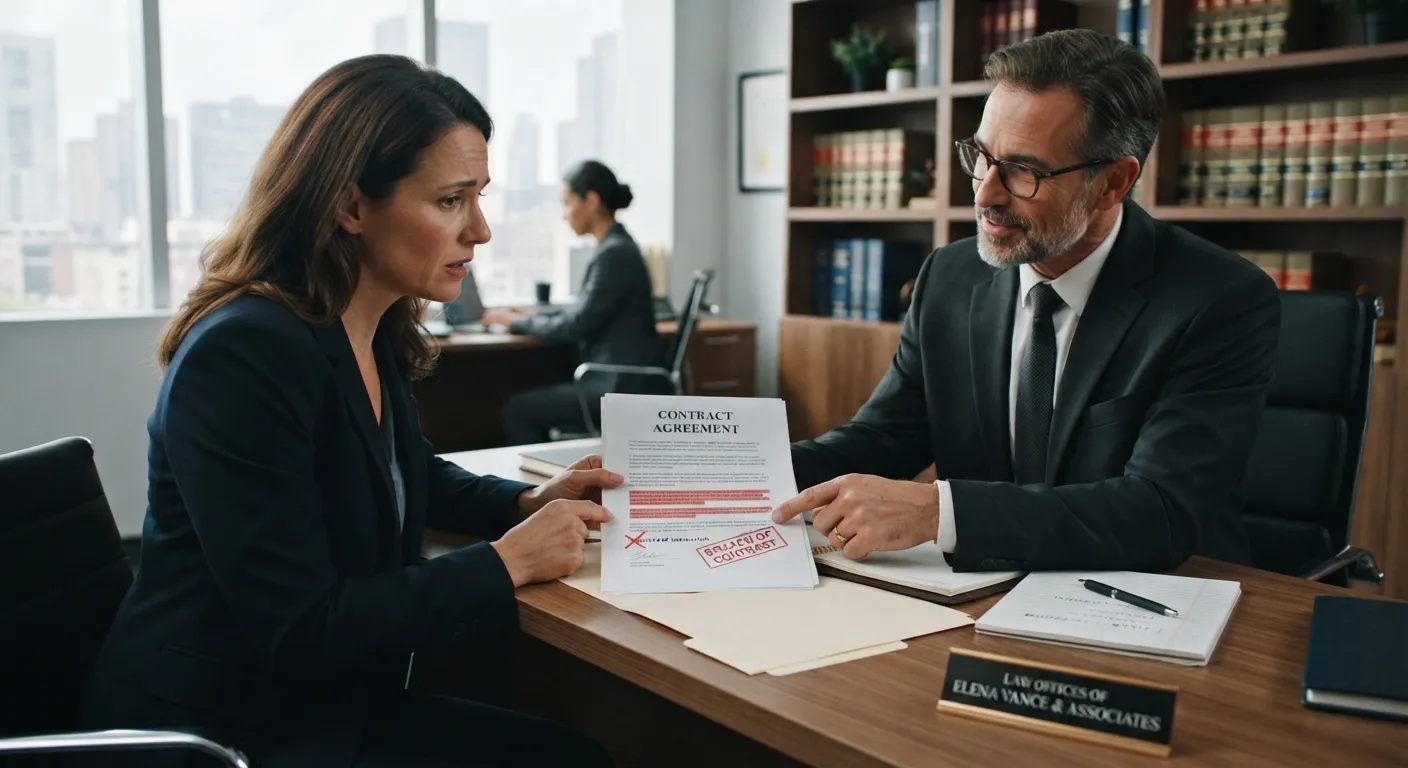
A breach of contract occurs when a party who has entered into a contract fails to perform a promised obligation. The failure may involve not performing at all, performing improperly, performing only part of the obligation, or failing to perform when required by the agreement.
For a contract claim to succeed, the agreement generally needs to be legally enforceable. Contract law commonly considers factors such as mutual assent, consideration, capacity, and legality, although the exact requirements and interpretation can vary by jurisdiction and type of contract.
For example, suppose a business hires a contractor to install a commercial sign by a specified date. If the contractor does not perform the agreed work without a legally recognized excuse, the failure may constitute a breach.
However, not every disagreement over a contract means that a breach has occurred. The wording of the agreement, the parties' conduct, applicable law, and circumstances surrounding the performance all matter.
A contract can be breached in different ways. Identifying what happened can help determine what remedies may be available.
The most straightforward situation occurs when a party does not perform an obligation at all.
For example, a company may agree to deliver equipment by a specified date but fail to deliver it. If the contractual obligation was valid and no applicable excuse exists, the failure to perform may constitute a breach.
A party may perform an obligation but do so after the deadline established by the contract.
Whether late performance constitutes a breach depends on the contract terms and circumstances. Some agreements make timing especially important, while others may allow additional time or provide procedures for addressing delays.
A party may attempt to perform but fail to meet contractual requirements.
Examples might include a contractor completing work that does not conform to agreed specifications or a supplier delivering goods that do not satisfy the contract.
The significance of the deficiency can depend on the wording of the agreement, the nature of the performance, and applicable law.
A party may complete only part of its contractual obligations.
Partial performance does not always have the same legal consequences as complete nonperformance. Contract structure, whether obligations are divisible, and the extent of the performance can affect the parties' rights.
A party may sometimes indicate before the performance deadline that it will not fulfill its contractual obligations.
This can create an anticipatory breach or repudiation issue. The legal consequences depend on the circumstances and governing law, including whether the other party has rights to treat the contract as breached and seek a remedy.
Discovering a breach does not necessarily mean that litigation is the immediate next step. A careful response can help preserve evidence and potentially resolve the dispute more efficiently.
Start by reading the entire agreement rather than focusing only on the provision that appears to have been violated.
Look for terms concerning:
The contract may explain what the parties are expected to do after a breach occurs.
Some agreements require one party to provide written notice and allow the other party an opportunity to correct the problem before further action can be taken.
Create a clear record of the events surrounding the alleged breach.
Keep relevant:
Documentation can help establish what the parties agreed to, what was performed, what was not performed, and what losses resulted.
If appropriate, notify the other party about the problem.
A written communication can identify the relevant contractual obligation, explain what you believe has not been performed, describe what you are requesting, and provide any deadline required under the agreement.
Keep communications factual and professional. Avoid making unsupported accusations or threats.
In some cases, a straightforward conversation or written notice may resolve the dispute without litigation.
Some contracts give the breaching party a specified period to correct a problem.
For example, an agreement may state that a party has 30 days after receiving written notice to cure a particular breach.
If the contract contains such a provision, follow its requirements carefully. Failing to comply with a contractual notice or cure procedure can complicate a later dispute.
If the breach caused financial harm, keep records showing how the loss was calculated.
Depending on the situation, this might include:
Contract damages generally seek to place the non-breaching party in the economic position they would have occupied if the contract had been performed, subject to applicable legal limitations.
The remedy available after a breach depends on the contract, applicable law, the type of loss, and the circumstances.
Monetary damages are a common remedy for breach of contract.
Expectation damages generally aim to put the non-breaching party in the position they would have occupied if the contract had been fully performed.
For example, if a supplier agreed to provide goods at a particular price but failed to do so and the buyer reasonably had to obtain substitute goods at a higher cost, the difference may be relevant to the damages analysis, depending on the applicable law and circumstances.
Reliance damages may compensate certain expenses incurred because a party reasonably relied on the contract or promise.
The purpose is generally to compensate for an economic position resulting from reliance rather than simply awarding the benefit expected from complete performance.
Some breaches can cause losses beyond the immediate value of the promised performance.
Consequential damages may be available for certain losses that result from a breach and satisfy applicable legal requirements, including foreseeability and proof. The rules vary depending on the jurisdiction and type of contract.
Because consequential damages can be more difficult to establish, detailed documentation of the losses and their connection to the breach may become particularly important.
Some contracts contain a liquidated damages clause that establishes an amount or formula for damages if a specified breach occurs.
These provisions can provide greater certainty about the financial consequences of a breach, particularly where actual losses may be difficult to calculate. However, a liquidated damages provision generally cannot simply function as an unlawful penalty. Courts may examine whether the provision is legally enforceable under the applicable law.
Money is not always an adequate remedy.
In limited circumstances, a court may order the breaching party to perform the contractual obligation. This remedy is known as specific performance.
Specific performance is generally associated with situations involving unique property or other circumstances in which monetary damages would not adequately compensate the non-breaching party.
For example, unique real estate may be treated differently from ordinary goods that can be purchased elsewhere.
Restitution can involve returning a benefit that one party received from another when retaining that benefit would be inequitable.
The availability and scope of restitution depend on the circumstances and applicable law.
No.
A breach of contract does not automatically mean that the non-breaching party will recover every amount they believe they lost.
The party seeking damages generally needs to establish the legal basis for the claim and the losses that are recoverable under the applicable law. Contract remedies are generally compensatory rather than punitive, and punitive damages are ordinarily not available for a straightforward breach of contract.
The contract itself can also affect the parties' rights. It may contain limitations on liability, liquidated damages provisions, dispute-resolution requirements, or other terms that influence how a dispute is handled.
A party harmed by a breach generally has a duty to take reasonable steps to limit or mitigate the resulting losses.
For example, if a supplier fails to deliver equipment and a reasonable substitute is available, the affected party may need to take reasonable steps to avoid allowing losses to grow unnecessarily.
The exact mitigation requirements depend on the applicable law and circumstances. Failure to reasonably mitigate damages can affect the amount that may ultimately be recovered.
Mitigation does not mean that a person must take unreasonable measures or accept any possible alternative regardless of cost or practicality. The question is generally what reasonable steps were available under the circumstances.
A breach-of-contract dispute often depends heavily on documentation.
The agreement is usually the starting point. Make sure you have the signed version and any amendments, addenda, schedules, or attachments that form part of the agreement.
Emails, letters, messages, and other communications may help establish what the parties discussed before and after the contract was signed.
Invoices, receipts, bank records, canceled checks, and other payment documentation can help establish whether contractual financial obligations were fulfilled.
Depending on the dispute, useful evidence may include delivery records, project schedules, photographs, inspection reports, work logs, or other records showing what was actually done.
People who directly observed relevant events may have information about performance, communications, deadlines, or other facts involved in the dispute.
Evidence should be preserved lawfully and organized so that each document can be connected to a specific issue.
Yes. Many contract disputes can potentially be resolved without a lawsuit.
Negotiation is one common option. The parties may agree to payment, additional performance, revised deadlines, replacement goods or services, or another solution.
Mediation is another possibility. A neutral third party helps the parties communicate and explore a voluntary settlement but generally does not decide the dispute for them.
Some contracts require mediation or another dispute-resolution process before a lawsuit can be filed.
Arbitration may also be required by some agreements. Unlike mediation, arbitration generally involves a neutral decision-maker who considers the dispute and issues a decision according to the applicable arbitration agreement and rules.
Always review the dispute-resolution provisions in the contract before filing a lawsuit.
A lawsuit may become an option when:
A lawsuit is not always the most practical response. Litigation can involve filing fees, legal costs, time, document exchange, hearings, and other procedural requirements.
Before filing, consider the amount at stake, the strength of the evidence, the likely remedies, the contract's dispute-resolution provisions, and whether the other party may be willing to settle.
A party accused of breaching a contract may have legal defenses.
For example, the defendant may argue that:
The appropriate defense depends on the facts, contract language, and governing law.
Not every contract must be written to be enforceable.
Some oral agreements can create legally enforceable contracts when the necessary elements of contract formation are present. However, certain categories of agreements are subject to laws requiring a writing, commonly associated with the Statute of Frauds.
Because the requirements vary depending on the type of agreement and jurisdiction, the absence of a signed written contract does not automatically answer whether a legal obligation existed.
Other evidence, such as emails, messages, invoices, payments, or testimony about the parties' agreement and conduct, may become relevant.
Contracts involving the sale of goods can be governed by Article 2 of the Uniform Commercial Code (UCC), as adopted and modified by individual states. Contract rules for services, real estate, employment, and other arrangements can involve different legal principles.
This distinction matters because a dispute over a shipment of products may be treated differently from a dispute involving professional services or real estate.
When a contract dispute involves commercial goods, the applicable state's version of the UCC should be considered alongside the contract itself.
There is no single nationwide deadline for every breach-of-contract claim.
The applicable statute of limitations can depend on the state, type of contract, legal theory, and circumstances. The contract may also contain provisions affecting dispute procedures, although contractual provisions cannot necessarily override every applicable legal requirement.
Because waiting too long can affect the ability to pursue a claim, someone dealing with a significant breach should identify the applicable deadline promptly.
Legal advice may be useful when a contract dispute involves significant money, complicated terms, multiple parties, business relationships, disputed interpretations, or a potential lawsuit.
An attorney can review the agreement, identify potentially relevant legal issues, evaluate available evidence, explain possible remedies, and discuss whether negotiation, mediation, arbitration, or litigation may be appropriate.
Legal advice can also be useful before sending a formal demand when the wording of the communication could affect future negotiations or litigation.
A contract may specify how and when a breach must be reported. Review those provisions before sending notice.
Important conversations should be documented where appropriate. Written records can help establish what was communicated and when.
Do not delete relevant messages, emails, records, photographs, or documents after a dispute develops.
If reasonable steps can reduce losses caused by a breach, delaying those steps may affect potential damages.
Negotiation, mediation, or contractual dispute-resolution procedures may provide alternatives to litigation.
Contract claims can be subject to statutes of limitations and contractual procedures. Waiting can create unnecessary risk.
The legal effect of a breach depends on the agreement, the nature of the breach, and applicable law. Do not assume that all remaining contractual duties disappear automatically.

A breach of contract can disrupt a business relationship, purchase, project, or personal agreement, but the appropriate response depends on the specific contract and applicable law. Before taking legal action, review the agreement carefully, document what happened, preserve relevant evidence, calculate your losses, and check for notice, cure, dispute-resolution, and deadline requirements.
Depending on the circumstances, negotiation or mediation may resolve the dispute without litigation. When a breach causes significant losses or involves complicated contractual terms, legal advice can help clarify available remedies and the steps that may be appropriate.
Because contract law is largely governed by state law in the United States, the rules that apply to one agreement or jurisdiction may not apply to another. A careful review of the actual contract and applicable law is therefore essential before deciding how to proceed.
Written by
FranklyFrankly is a legal researcher and content writer at Jurnza, specializing in legal services, legal tools, legal guides, and law-related educational content. Frankly researches topics including business law, family law, immigration law, personal injury law, tax law, employment law, and real estate law to create accurate, easy-to-understand, and up-to-date resources that help readers make informed legal decisions.
