Document Generators
Injury & Compensation
Fees & Support
Deadlines & Filing

Learn how a Williamsburg car accident attorney helps injured victims understand their legal options, deal with insurance companies, document losses, and pursue compensation after a crash.
A car accident in Williamsburg, Virginia, can create serious physical, financial, and legal problems. You might face medical bills, vehicle repairs, lost income, insurance disputes, and a long recovery.
When another driver causes your crash, you need clear information about your rights and available options. A Williamsburg car accident attorney helps you understand Virginia personal injury law, gather evidence, communicate with insurance companies, and pursue compensation for eligible losses.
This guide explains what to do after a Williamsburg car accident, how insurance claims work, what compensation might include, and when legal representation makes sense.
Your first priority after a crash should be safety and medical care.
Follow these steps when possible:
Avoid arguing with the other driver. Do not admit fault at the accident scene.
A simple statement such as "I am sorry" might later create confusion about responsibility. Stick to factual information when speaking with police, medical professionals, and insurers.
Some injuries appear immediately. Others develop over the following hours or days.
Common symptoms include:
Seek medical attention when you experience symptoms after a collision.
Medical records also create documentation of your diagnosis and treatment. Follow your healthcare provider's recommendations and attend scheduled appointments.
Keep copies of:
A consistent medical record helps connect your injuries with the accident.
Car crashes happen for different reasons. Identifying the cause helps establish responsibility.
Distracted driving includes activities such as texting, phone use, eating, adjusting navigation systems, or looking away from traffic.
A distracted driver might fail to notice a stopped vehicle, pedestrian, traffic signal, or changing road conditions.
Speeding reduces the time available to react to hazards. Higher speeds also increase the force involved in a collision.
Drivers must follow traffic signals and right-of-way rules. Failure to yield often causes intersection crashes.
Entering an intersection against a red light creates a serious risk of side-impact collisions.
A driver who changes lanes without checking surrounding traffic might strike another vehicle.
A driver needs enough stopping distance to respond when traffic slows suddenly.
Alcohol and drug impairment affects judgment, coordination, reaction time, and attention.
Fatigue affects alertness and reaction speed. Long driving periods and insufficient sleep increase the risk of crashes.
Brake failures, worn tires, defective lights, and other mechanical problems might contribute to a collision.
Poor lighting, construction zones, damaged pavement, missing signs, and other roadway conditions might contribute to an accident.
Responsibility depends on the specific facts and applicable law.
Car accidents produce different types of injuries.
Common examples include:
Some injuries require weeks or months of treatment.
Severe injuries might require surgery, rehabilitation, physical therapy, medication, or long-term care.
Your attorney needs accurate medical information to evaluate the effect of your injuries on your life and finances.
Fault depends on evidence.
Evidence might include:
An attorney reviews available evidence to determine how the collision happened and whether another party might be responsible.
Do not assume fault based only on what another driver tells you at the accident scene.
Virginia follows a contributory negligence system. This rule makes fault a major issue in personal injury cases.
If an injured person is found to have contributed to the accident, the result might affect the person's ability to recover damages.
This makes accident evidence especially important.
For example, a driver might claim another motorist was speeding. The injured driver might provide evidence showing the other vehicle ran a red light.
Witness accounts, photographs, video footage, police reports, and other evidence might help establish what happened.
Because contributory negligence issues are fact-specific, speak with a Virginia attorney before assuming another driver's statement determines your claim.
There is no standard settlement amount for every car accident.
Potential compensation depends on the injuries, financial losses, insurance coverage, liability evidence, and other factors.
A claim might involve:
Medical costs might include emergency treatment, doctor visits, diagnostic tests, medication, physical therapy, surgery, rehabilitation, and other accident-related care.
A serious injury might prevent you from working.
Documentation might include:
Some injuries affect a person's ability to perform the same work in the future.
A claim involving reduced earning capacity requires evidence about the injury, employment, income, skills, and future work limitations.
Vehicle repairs or replacement costs might form part of an accident claim.
Keep:
Serious injuries might cause physical pain, emotional distress, reduced mobility, sleep problems, and limitations on daily activities.
The amount associated with these losses depends on the facts of the individual case.
Virginia has specific automobile insurance requirements.
The Virginia Department of Motor Vehicles states that policies effective on or after January 1, 2025, must meet minimum liability limits of:
These limits apply to the statutory minimum requirements. Drivers might carry higher limits or additional coverage.
Insurance coverage plays an important role when evaluating an accident claim.
A crash involving an uninsured driver creates additional complications.
Your own insurance policy might provide uninsured motorist coverage.
Review your policy carefully after an accident.
Keep copies of:
Do not assume an uninsured driver means you have no recovery options.
A lawyer can review the available coverage and explain your options based on the policy and accident circumstances.
An underinsured driver has insurance, but the available coverage might not fully address the losses from a serious accident.
For example, your medical expenses and other losses might exceed the other driver's liability coverage.
Your own policy might provide underinsured motorist protection.
Coverage depends on the policy terms and applicable Virginia law.
After an accident, the insurance company investigates the claim.
The process often includes:
Insurance adjusters might ask questions about the accident and your injuries.
Answer factual questions accurately. Do not guess about information you do not know.
For serious injury claims, consider getting legal advice before providing detailed statements about fault or the extent of your injuries.
Insurance companies might deny claims for different reasons.
Common disputes involve:
Read the denial letter carefully.
Identify the reason for the denial. Keep copies of every letter, email, message, and document.
A denial does not automatically determine your legal rights.
An attorney reviews the evidence and insurance position before advising you about further action.
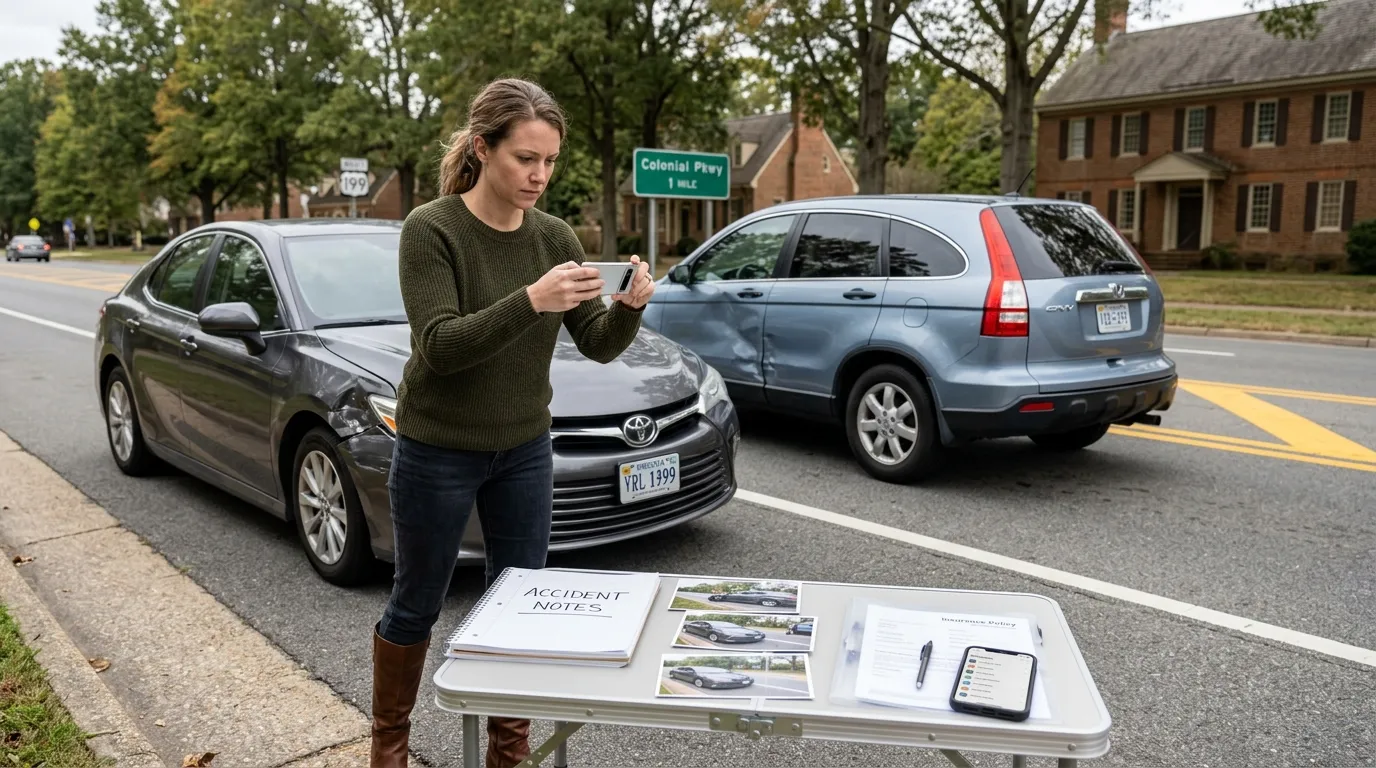
Evidence often becomes harder to obtain as time passes.
Save:
If a nearby business or traffic system recorded the crash, footage might have limited retention periods.
Prompt action helps preserve relevant evidence.
Virginia law establishes deadlines for personal injury claims.
Virginia Code Section 8.01-243 generally provides a two-year limitation period for personal injury actions, subject to statutory exceptions.
The exact deadline depends on the circumstances.
Different rules might apply to cases involving government entities, wrongful death, minors, property damage, or other special circumstances.
Do not wait until the deadline approaches before seeking legal advice.
Evidence often becomes harder to preserve with time.
Shared fault requires careful legal analysis in Virginia.
Because Virginia follows contributory negligence principles, your percentage of responsibility might have serious consequences for a personal injury claim.
For example, suppose another driver ran a red light but claims you were speeding.
The case might involve:
Do not accept another driver's version of events without reviewing the evidence.
A fatal collision creates serious legal and financial issues for surviving family members.
Virginia has specific wrongful death procedures and deadlines.
Virginia Code Section 8.01-244 generally provides a two-year period for bringing a wrongful death action after the person's death, subject to statutory provisions and exceptions.
A wrongful death claim might involve losses related to:
Families should seek legal advice quickly after a fatal accident because wrongful death claims involve specific procedural requirements.
Legal representation becomes especially important when:
A lawyer reviews the facts and explains the available legal options.

An attorney might assist with several parts of your claim.
The attorney reviews available evidence and identifies potential sources of information.
Medical documentation helps establish the nature and extent of your injuries.
Your attorney reviews the available liability, uninsured motorist, and underinsured motorist coverage.
The attorney reviews medical expenses, lost income, property damage, future losses, and other applicable damages.
Your attorney handles claim-related communications and negotiations.
The attorney presents evidence supporting your claim and evaluates settlement proposals.
If negotiations fail, your attorney explains whether litigation is appropriate and handles the legal process if you decide to proceed.
Before hiring an attorney, ask practical questions.
Ask how often the attorney handles Virginia car accident cases.
Ask how the attorney would approach your specific circumstances.
Ask who will communicate with you and how often you should expect updates.
Ask how attorney fees work and what case expenses might apply.
Ask what happens if the insurance company refuses to provide a reasonable settlement.
Ask what documents and information you should preserve.
Clear answers help you understand the legal relationship before moving forward.
Attorney fees depend on the lawyer and the agreement you sign.
Many personal injury attorneys use contingency fee arrangements. Under such an arrangement, the attorney's fee generally depends on the recovery obtained.
The exact fee percentage, expenses, and other terms vary.
Read the fee agreement before signing.
Ask about:
You should understand the financial terms before hiring legal counsel.
After a Williamsburg car accident, focus on documentation and medical care.
Follow these steps:
A Williamsburg car accident involves Virginia law and local circumstances.
A local attorney might understand regional roads, courts, medical providers, insurance practices, and other factors relevant to your case.
Your attorney should still evaluate your claim based on evidence rather than assumptions.
Local knowledge should support a case-specific legal strategy.
A Williamsburg car accident might create medical, financial, and legal challenges. Your response after the crash matters.
Get medical care. Preserve evidence. Document your losses. Follow your insurance requirements. Avoid making statements about fault without understanding the consequences.
If you suffered serious injuries, lost income, or face an insurance dispute, a Williamsburg car accident attorney can review your situation and explain your legal options.
Virginia personal injury law includes strict deadlines and specific rules. The general personal injury limitation period is two years under Virginia Code Section 8.01-243, subject to statutory exceptions.
Your potential claim depends on the accident facts, evidence, injuries, insurance coverage, and applicable law. A qualified Virginia attorney should review your circumstances before you make decisions about settlement or litigation.
Written by
FranklyFrankly is a legal researcher and content writer at Jurnza, specializing in legal services, legal tools, legal guides, and law-related educational content. Frankly researches topics including business law, family law, immigration law, personal injury law, tax law, employment law, and real estate law to create accurate, easy-to-understand, and up-to-date resources that help readers make informed legal decisions.
