Document Generators
Injury & Compensation
Fees & Support
Deadlines & Filing

Tenant rights protect renters from certain unlawful landlord actions involving eviction, discrimination, retaliation, privacy, repairs, security deposits, and housing conditions. However, landlord-tenant laws vary by state and locality, so the rules governing notice, rent increases, property access, repairs, and eviction can differ. This guide explains what landlords generally can and cannot do and what tenants can do when a rental dispute arises.
Renting a home comes with responsibilities for both the tenant and the landlord. Tenants are generally expected to pay rent on time, follow the lease, take reasonable care of the property, and comply with applicable rental rules. Landlords, meanwhile, have legal responsibilities concerning the condition of the property, privacy, fair housing, eviction procedures, and the handling of certain tenant complaints, but this doesn't deprive tenant rights'.
Understanding these responsibilities is important because a landlord's authority over a rental property is not unlimited. Once a tenant lawfully occupies a property, the landlord generally cannot simply enter whenever they want, remove the tenant without following the required legal process, discriminate against the tenant, or use certain forms of harassment or retaliation.
At the same time, tenant rights are not identical everywhere in the United States. Federal laws establish important protections, particularly concerning housing discrimination and certain federally assisted housing, while state and local laws can govern matters such as landlord entry, security deposits, repairs, rent increases, notice periods, and eviction procedures. The U.S. government specifically advises renters to review their lease and consult their state or local housing authorities when dealing with landlord disputes.
This guide explains common tenant rights in the United States, what landlords generally can and cannot do, how eviction and retaliation rules work, and what renters can do when they believe their rights have been violated.
Important: This article provides general legal information, not legal advice. Landlord-tenant laws vary by state, county, and city. Your lease may also contain legally enforceable terms that affect your rights and responsibilities. If you are facing eviction, discrimination, unsafe housing, or another serious dispute, consider speaking with a qualified attorney or local legal aid organization.

Tenant rights are the legal protections and responsibilities that apply to people who rent residential property. These rights can come from federal law, state statutes, local ordinances, housing regulations, the rental agreement, and sometimes court decisions.
The exact rights available to a tenant depend on the circumstances. For example, a tenant renting a privately owned apartment may be covered by state landlord-tenant law and federal fair housing protections. A tenant living in certain federally assisted housing may have additional protections.
Tenant rights can address issues such as:
Not every right applies in every situation. A landlord may have legitimate legal reasons to inspect a property, enter for repairs, terminate a tenancy, or pursue an eviction. The key issue is whether the landlord is following the applicable law and lease requirements.
Landlords have legitimate rights as property owners and housing providers. Tenant protections do not mean that landlords lose control over their property.
Depending on state and local law, a landlord may generally be able to:
However, these rights have limits.
For example, a landlord's right to collect rent does not necessarily allow the landlord to use illegal collection tactics. A landlord's right to enter does not mean they can enter whenever they want. A landlord's right to evict does not generally mean they can simply change the locks and force a tenant out without following applicable procedures.
The CFPB notes that renters have local, state, and federal rights and specifically identifies practices such as changing locks to force someone out without a court order, refusing necessary repairs, and endangering tenant health or safety as situations that can raise legal concerns.
Although the precise rules vary by jurisdiction, landlords generally cannot ignore federal housing discrimination laws or use unlawful methods to remove or punish tenants.
Depending on the circumstances and applicable law, a landlord may be prohibited from:
The exact legal test depends on the jurisdiction and facts.
That is why a tenant who believes a landlord has acted improperly should preserve documentation and determine which specific law or lease provision applies rather than relying solely on a general statement that "landlords can't do that."
One of the most important things to understand about tenant rights is that there is no single nationwide landlord-tenant rule covering every ordinary rental dispute.
Federal law establishes certain protections, but many everyday rental issues are controlled by state and local law.
For example, state or local law may determine:
The U.S. government's tenant-rights guidance recommends checking state resources, including applicable attorneys general or housing agencies, when resolving landlord disputes.
This state-by-state variation is particularly important when discussing eviction, security deposits, rent increases, and landlord entry.
Tenants generally have a right to privacy and possession of the rental property during the tenancy, but landlords may have legal rights to enter in certain circumstances.
The exact notice requirements differ significantly between jurisdictions.
A lease may also contain provisions addressing landlord access, provided those provisions comply with applicable law.
Common reasons a landlord may be permitted to enter include:
An emergency is generally treated differently from a routine inspection. If there is a serious threat to life, safety, or property, immediate entry may be legally justified even where advance notice would normally be expected.
For ordinary inspections or repairs, however, the landlord may be required to provide advance notice.
Repeated unauthorized entry can become a serious tenant-rights issue.
A tenant should document:
The tenant should then review the lease and applicable state or local law.
If the conduct continues, the tenant may consider contacting a local housing agency, legal aid organization, or attorney.
Importantly, a tenant should avoid physically confronting or threatening a landlord. A written record is usually more useful than an escalating personal dispute.
Emergency situations can be treated differently from ordinary access.
For example, a landlord may need immediate access if there is:
The precise definition of an emergency depends on applicable law and circumstances.
A landlord should not automatically characterize every routine maintenance issue as an emergency merely to avoid ordinary notice requirements.
Likewise, a tenant generally should not assume that a landlord needs advance notice before addressing a genuine emergency.
Landlords generally have legal obligations concerning the condition of rental housing, although the precise requirements vary by jurisdiction and by the type of property.
A landlord may be responsible for addressing conditions that affect health, safety, or basic habitability.
Potentially serious issues can include:
The tenant also has responsibilities.
For example, tenants may be required to:
The CFPB states that renters have rights that can include protection against landlords refusing necessary repairs or endangering tenant health and safety.
The first step is generally to notify the landlord promptly.
Whenever possible, make the request in writing.
Instead of simply saying:
"The apartment is broken."
A tenant should provide specific information, such as:
Photos and videos can also be useful.
If the landlord fails to address a serious problem, the tenant should investigate the remedies available under state and local law before withholding rent, paying for repairs and deducting the cost, terminating the lease, or taking another legal step.
These remedies are not automatically available everywhere, and using the wrong procedure can create additional problems for the tenant.
Whether and how a landlord can increase rent depends on the lease and applicable law.
For a fixed-term lease, the landlord generally cannot simply change the agreed rent in the middle of the lease unless the lease or applicable law allows it.
For a month-to-month tenancy, a landlord may often be able to increase rent by providing the legally required notice, subject to applicable rent-control or other local restrictions.
However, rent increases can become legally problematic if they are discriminatory or retaliatory.
For example, federal fair housing law prohibits discrimination in housing based on protected characteristics, and federal law also prohibits retaliation for exercising certain fair housing rights.
Some state and local laws may provide additional protections.
Therefore, a tenant who receives an unexpected rent increase should examine:
A landlord does not necessarily have to renew every residential lease.
Whether a landlord can refuse to renew depends on factors including:
A landlord may have legitimate reasons for choosing not to renew a lease where the law permits it.
However, a nonrenewal cannot be used as a disguise for prohibited discrimination or retaliation.
For example, HUD explains that retaliation for exercising rights under the Fair Housing Act is prohibited.
This distinction matters because the mere fact that a tenant's lease was not renewed does not automatically establish unlawful conduct. The reason for the action and the applicable law must be considered.
Generally, landlords must follow applicable legal procedures when terminating a tenancy and pursuing eviction.
A landlord may have grounds for eviction, such as:
But having a potential legal reason for eviction does not necessarily allow a landlord to bypass the required process.
An eviction is generally a legal proceeding, and the specific notices, filing requirements, hearings, and enforcement procedures vary by jurisdiction.
A self-help eviction occurs when a landlord attempts to force a tenant out without following the legally required eviction process.
Examples can include:
The CFPB specifically warns that landlords cannot force tenants out by changing locks without a court order in the circumstances covered by its tenant-rights guidance.
If a landlord attempts to remove a tenant without lawful authority, the tenant should seek legal assistance quickly.
An eviction lawsuit generally begins after the landlord provides the notice required by applicable law.
If the tenant does not leave or resolve the issue, the landlord may file a case in court.
The tenant may have an opportunity to:
The exact process varies by state.
The CFPB notes that tenants facing eviction may have the right to file a written answer explaining why they should not be evicted and recommends looking into state and local protections and legal assistance.
Ignoring an eviction lawsuit can be risky because a court may enter a judgment without hearing the tenant's side if the tenant fails to respond appropriately.
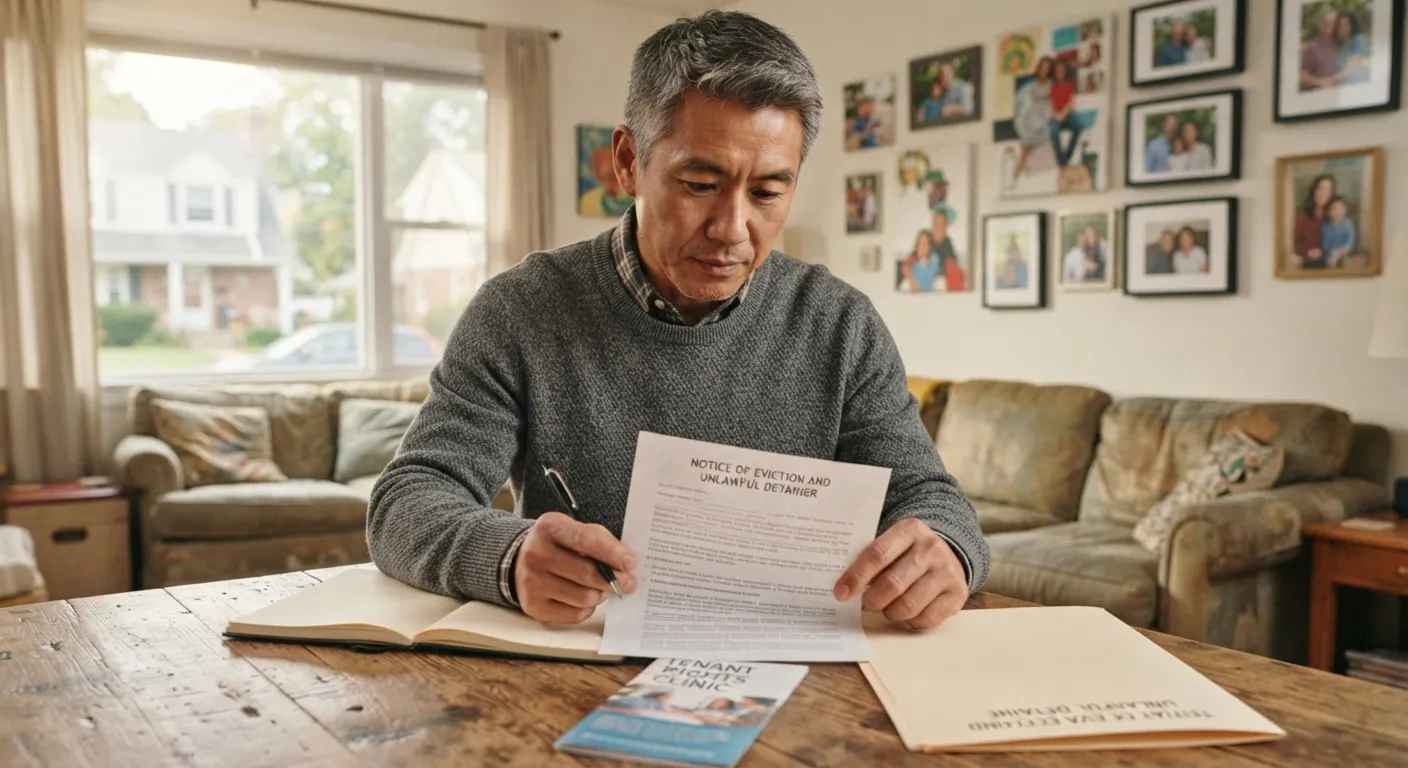
Retaliation is an important tenant-rights issue.
A landlord may generally have the right to evict a tenant for a legitimate lawful reason, such as nonpayment of rent. But state or local laws may protect tenants from retaliation for certain protected activities.
Examples can include reporting:
The exact retaliation protections vary by jurisdiction.
Federal fair housing law separately prohibits retaliation against individuals for exercising rights protected by the Fair Housing Act. HUD states that retaliation can include actions such as eviction or threats of eviction because someone reported discrimination or otherwise exercised fair housing rights.
Retaliation can be difficult to establish because a landlord may have another legitimate explanation for an action.
A tenant should preserve evidence such as:
A timeline can be particularly helpful.
For example:
Day 1: Tenant reports a serious housing problem.
Day 5: Tenant contacts a housing agency.
Day 7: Landlord threatens eviction.
Day 10: Tenant receives an eviction notice.
The timing alone may not prove retaliation, but documentation can help an attorney or court evaluate the circumstances.
Housing discrimination occurs when a housing provider treats someone unlawfully differently because of a protected characteristic.
The federal Fair Housing Act prohibits discrimination in housing because of:
HUD explains that the Fair Housing Act applies to nearly all housing, including private housing, public housing, and federally funded housing, although specific exemptions and additional laws can affect particular situations.
The Department of Justice similarly identifies these protected categories under the federal Fair Housing Act.
State and local laws may protect additional characteristics beyond those covered by federal law.
Potential discriminatory conduct can occur at many stages of a rental relationship.
Examples can include:
Housing discrimination is not limited to refusing to rent an apartment.
It can involve advertising, application decisions, rental terms, conditions, maintenance, eviction, and other housing-related activities.
Federal fair housing law provides protections for people with disabilities.
Depending on the circumstances, a tenant may be entitled to a reasonable accommodation that allows them to use and enjoy their home.
The specific accommodation depends on the person's disability-related needs and the circumstances of the request.
Examples can potentially include changes to certain rules or policies when legally required.
The law concerning reasonable accommodations is fact-specific. A landlord may be entitled to information needed to evaluate whether a requested accommodation is necessary and reasonable, but cannot simply reject a lawful request because they do not want to make any changes.
Tenants with disability-related housing concerns should consider obtaining guidance from HUD, a fair housing organization, or a qualified attorney.
The Fair Housing Act includes familial status among its protected categories.
This generally protects families with children from discrimination in covered housing.
For example, a landlord generally cannot impose different rental conditions simply because a tenant has children when the conduct violates applicable fair housing law.
However, housing laws contain specific rules and limited exceptions, including certain housing that qualifies under federal requirements for older persons.
Because familial-status rules can be fact-specific, tenants who believe they are being treated differently because they have children should consider seeking advice rather than assuming every child-related rental rule is automatically unlawful.
Sexual harassment can violate fair housing law.
A landlord or housing provider may not use housing as leverage for unwanted sexual conduct.
Examples of potentially unlawful conduct can include:
The CFPB specifically identifies sexual harassment as a prohibited form of landlord conduct in its tenant-rights guidance.
Tenants experiencing harassment should preserve messages, emails, recordings where legally permitted, notices, and other evidence and consider contacting law enforcement where appropriate, HUD, a fair housing organization, or legal counsel.
Federal law prohibits retaliation against individuals for exercising certain Fair Housing Act rights.
For example, HUD states that retaliation is illegal when someone makes an allegation, assists in a proceeding, or otherwise participates in the HUD fair housing complaint process. HUD also explains that retaliation can involve someone reporting discriminatory practices to a housing provider or another authority.
Possible retaliatory conduct can include:
A landlord may still take lawful action for legitimate reasons unrelated to the protected activity. The central issue is whether the action was taken because of the tenant's protected conduct.
Federal law provides certain housing protections for survivors of domestic violence, dating violence, sexual assault, and stalking.
The Violence Against Women Act (VAWA) provides specific protections in covered federally assisted housing programs.
HUD explains that covered survivors may have protections involving admission, eviction, termination of assistance, emergency transfers, confidentiality, and other housing rights.
VAWA also protects the right to seek law enforcement or emergency assistance from one's home in covered circumstances, and HUD explains that people cannot be penalized for seeking such assistance under the relevant federal protections.
These protections are important, but they do not mean that every tenant in every privately owned rental property receives identical VAWA protections. Coverage depends on the applicable federal program and circumstances.
State and local laws may provide additional protections.
A tenant's right to seek emergency assistance can be protected under federal law in certain circumstances.
HUD explains that VAWA provides protections against penalties for seeking law enforcement or emergency assistance and that certain protections apply beyond federally assisted housing.
For example, a tenant should not automatically be treated as violating a housing rule simply because they contacted emergency services for help in a situation protected by applicable law.
However, the exact circumstances matter.
A tenant should document:
If the landlord threatens eviction or another penalty because the tenant sought protected emergency assistance, legal advice may be appropriate.
No.
A landlord generally cannot simply invent charges without regard to the lease and applicable law.
Potential charges can include:
Whether a particular charge is lawful depends on the rental agreement and state or local law.
The CFPB notes that landlords and collectors cannot demand certain fees, interest, or charges that were not agreed to or are prohibited by applicable law.
Tenants should therefore request an itemized explanation of disputed charges and compare them with the lease and applicable law.
Security deposits are designed to protect landlords against certain losses, such as unpaid rent or qualifying property damage, subject to applicable law.
However, a security deposit is not automatically the landlord's money to keep.
State and local laws can regulate:
A landlord may generally be able to deduct legitimate amounts permitted by law, but cannot necessarily keep the entire deposit simply because a tenant moved out.
Normal wear and tear generally refers to ordinary deterioration that occurs through normal use of the property.
Examples may include:
Significant tenant-caused damage is different.
Examples might include:
The distinction is fact-specific, and state law determines what deductions are permitted.
Tenants should photograph the property when moving in and moving out whenever possible.
A landlord may generally be permitted to deduct lawful charges from a security deposit, but the exact rules depend on state and local law.
If a landlord withholds money, the tenant may have the right to receive an itemized statement explaining the deductions.
A tenant who believes the deposit was wrongfully withheld should:
Do not assume that a landlord automatically loses the right to make deductions simply because the tenant disagrees with them. The legality of the deduction depends on the facts and applicable law.
A landlord generally cannot use essential utilities as a method of forcing a tenant out.
Utility responsibilities can vary according to the lease, property type, and applicable law.
The CFPB specifically identifies failing to pay for utilities under a landlord's control and endangering tenant health and safety as potential tenant-rights concerns.
If utilities are unexpectedly disconnected, the tenant should determine:
If the landlord intentionally disconnects essential services to pressure a tenant to leave, immediate legal assistance may be appropriate.
In many jurisdictions, landlords can enter to show a property to prospective tenants or buyers, particularly toward the end of a tenancy.
However, applicable notice requirements and reasonable access rules may apply.
A tenant should review the lease and local law before refusing lawful access.
At the same time, a landlord generally should not treat a right to show the property as unlimited authority to enter at any time.
If repeated showings become excessive or unreasonable, the tenant may want to communicate in writing and review the applicable legal standards.
A landlord generally cannot use a lockout as a substitute for the legally required eviction process.
The CFPB specifically states that landlords cannot force tenants out by changing their locks without a court order in the circumstances covered by its tenant-rights guidance.
If a tenant is locked out, they should consider contacting:
The tenant should also preserve evidence of the lockout and any related communications.
The best response depends on the type and seriousness of the violation.
A practical first step is to document everything.
Keep copies of:
Avoid relying only on phone conversations.
If you speak with the landlord by phone, consider following up with a written message confirming what was discussed.
For example:
"Thank you for speaking with me today. As discussed, the water leak in the bedroom remains unresolved, and you stated that someone would inspect it on Friday."
This creates a record without unnecessarily escalating the dispute.
This is an area where tenants need to be particularly careful.
A serious landlord violation does not automatically give every tenant the right to stop paying rent.
Some states provide remedies such as rent withholding, repair-and-deduct, rent escrow, or lease termination under specific conditions. Other jurisdictions impose strict procedural requirements.
If a tenant stops paying rent without following the applicable legal procedure, the landlord may attempt to use nonpayment as grounds for eviction.
Before withholding rent, a tenant should research the law in the relevant jurisdiction or obtain legal advice.
This is one of the situations where general internet advice can be dangerous because a remedy available in one state may not be available in another.
Potentially, yes.
A tenant may have legal claims against a landlord depending on the facts and applicable law.
Possible disputes can involve:
The available remedy may include damages, return of improperly withheld money, injunctive relief, statutory penalties, attorney's fees, or other remedies depending on the law.
Not every disagreement is necessarily a lawsuit, however.
Some disputes can be resolved through written communication, mediation, housing agencies, or administrative complaint procedures.
Tenants who cannot resolve a dispute directly with a landlord may have several options.
Many states have agencies that provide landlord-tenant information or enforce specific housing regulations.
Cities and counties may have housing or code-enforcement departments responsible for certain property conditions.
Low-income tenants may qualify for free or reduced-cost legal assistance.
The CFPB specifically recommends contacting a local bar association or legal aid organization when a tenant needs legal assistance.
HUD handles certain housing discrimination complaints and provides resources concerning fair housing.
HUD's Office of Fair Housing and Equal Opportunity allows individuals to report housing discrimination online or by phone.
If an eviction lawsuit has been filed, the court system becomes particularly important.
A tenant should not ignore court documents or assume that a landlord's claims are automatically valid.
Strong documentation can make a major difference.
A tenant should consider maintaining a chronological record.
For each significant event, record:
Date: When did it happen?
Event: What happened?
People involved: Who was present?
Evidence: Are there emails, texts, photos, videos, notices, or receipts?
Response: What did the tenant or landlord do afterward?
For example:
Date | Event | Evidence |
|---|---|---|
March 3 | Tenant reports major plumbing leak | Email + photos |
March 5 | Landlord acknowledges problem | Text message |
March 10 | No repair completed | Photos |
March 12 | Tenant contacts housing department | Complaint confirmation |
March 15 | Landlord sends eviction threat | Text message |
A timeline does not prove a legal claim by itself, but it can make the facts easier for an attorney, agency, mediator, or court to evaluate.
Tenants can unintentionally weaken their position by reacting emotionally to a landlord dispute.
The lease should be the first document reviewed when a dispute begins.
It may identify procedures for:
However, a lease cannot necessarily override mandatory protections established by law.
As discussed above, rent withholding can be permitted in some circumstances but not others.
Do not assume that a landlord's violation automatically excuses rent.
Important disputes should generally be documented in writing whenever practical.
An eviction notice or lawsuit should not be ignored.
A tenant may have defenses or procedural rights that can be lost if deadlines are missed.
Leaving may sometimes be appropriate, but a tenant facing a dispute should understand whether moving out could affect claims, rent obligations, security deposits, or other rights.
Keep original messages, emails, notices, photos, and documents.
Backups can also be useful.

Tenant rights are designed to create a legal balance between the interests of renters and landlords. Landlords have legitimate rights to collect rent, enforce lawful lease terms, maintain their property, access rental units in permitted circumstances, and pursue eviction when a lawful basis exists. Tenants, however, are also protected by federal, state, and local laws that can limit how those rights are exercised.
A landlord generally cannot treat a rental property as though the tenant has no legal right to privacy or possession. Illegal lockouts, discriminatory treatment, certain forms of retaliation, unlawful harassment, and failures to comply with applicable housing requirements can create serious legal issues. Federal law provides important protections against housing discrimination, while state and local laws often determine many of the day-to-day rules involving repairs, deposits, notices, rent, entry, and eviction.
For tenants, documentation is one of the most useful tools when a dispute arises. Keep the lease, payment records, repair requests, photographs, messages, notices, and other relevant evidence. If an eviction lawsuit, discrimination complaint, serious safety problem, or substantial financial dispute is involved, getting legal assistance early can help clarify the available options.
Most importantly, avoid assuming that a rule described online applies automatically to your situation. Landlord-tenant law is highly dependent on jurisdiction and facts. Before withholding rent, breaking a lease, refusing entry, challenging a security deposit, or responding to an eviction, review the law applicable where the property is located or speak with a qualified legal professional.
Written by
FranklyFrankly is a legal researcher and content writer at Jurnza, specializing in legal services, legal tools, legal guides, and law-related educational content. Frankly researches topics including business law, family law, immigration law, personal injury law, tax law, employment law, and real estate law to create accurate, easy-to-understand, and up-to-date resources that help readers make informed legal decisions.
