Document Generators
Injury & Compensation
Fees & Support
Deadlines & Filing
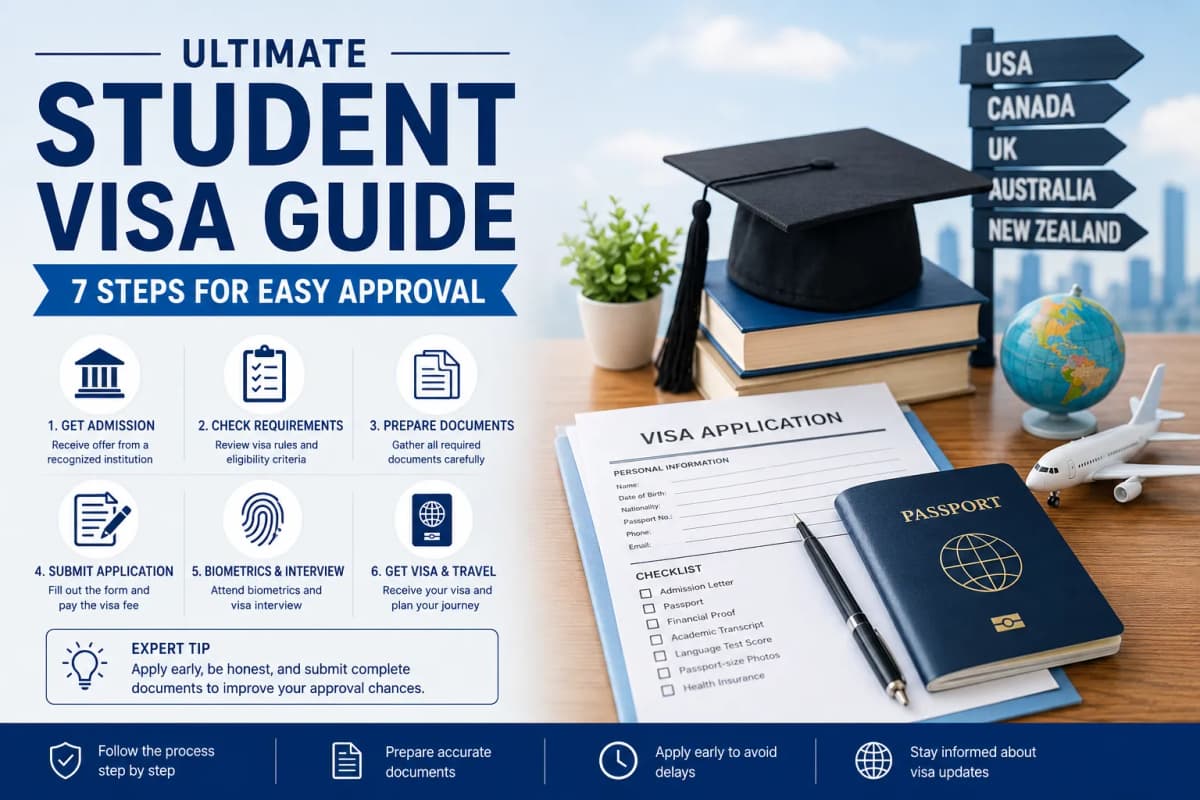
Planning to study abroad? This comprehensive Student Visa Guide explains eligibility requirements, required documents, application steps, visa interviews, financial proof, processing times, common mistakes, and practical tips to improve your chances of approval.

Studying abroad can open the door to world-class education, international career opportunities, and valuable cultural experiences. Before you can begin your academic journey, however, you'll usually need a student visa Guide that authorizes you to study in your chosen country.
The visa application process may seem overwhelming at first. Different countries have different immigration laws, documentation requirements, financial criteria, and application procedures. Missing a required document or providing inaccurate information can delay your application or even result in a refusal.
This Student Visa Guide explains everything you need to know—from understanding visa requirements and preparing documents to attending interviews and avoiding common mistakes. Whether you're planning to study in the United States, Canada, the United Kingdom, Australia, New Zealand, or another destination, this guide will help you navigate the process with confidence.
If you're still deciding where to study, you may also want to read our Study Abroad Guide /articles/study-abroad-guide for tips on choosing the right destination and university.
Important: Immigration policies change regularly. Always verify the latest requirements through the official immigration authority or embassy of your destination country before submitting your application.
A student visa is an official document or authorization issued by a country's immigration authority that allows an international student to enter and remain in the country for educational purposes.
Unlike tourist or business visas, student visas are specifically designed for individuals enrolled in approved educational institutions. Most student visas require applicants to maintain full-time enrollment and comply with immigration regulations throughout their studies.
Depending on the country, a student visa may also allow you to:
Because visa conditions differ from one country to another, always review the rules that apply to your destination before making travel arrangements.
A student visa is more than just an entry document—it provides the legal permission needed to pursue education abroad.
Without a valid visa, you may be:
Maintaining your visa status is equally important. Many countries require international students to remain enrolled full-time and follow all visa conditions to continue studying legally.
For more information about maintaining legal immigration status, see our Immigration Compliance Guide /articles/immigration-compliance-guide.
Although every country has its own immigration system, the purpose of a student visa remains the same: allowing international students to pursue approved educational programs.
Students accepted into approved U.S. educational institutions generally apply for one of several student visa categories, depending on the type of program they intend to study.
Applicants are usually required to provide:
Official information is available from the U.S. Department of State and U.S. Citizenship and Immigration Services (USCIS).
International students studying in Canada generally require a study permit issued by Immigration, Refugees and Citizenship Canada (IRCC).
Applicants typically need:
Students attending approved educational institutions usually apply through the UK Student visa route after receiving confirmation of admission from a licensed education provider.
Australia's student visa program allows eligible international students to undertake full-time education while meeting health, financial, and character requirements.
International students intending to complete long-term educational programs generally require a student visa supported by proof of enrollment and financial capacity.
Most countries allow international students to apply if they satisfy the required eligibility criteria.
Applicants are generally expected to have:
Meeting the minimum eligibility requirements does not automatically guarantee approval. Immigration officers evaluate each application individually based on the supporting evidence provided.
Although specific requirements vary by destination, many countries request similar documentation during the application process.
Requirement | Why It's Required |
|---|---|
Valid Passport | Confirms your identity and travel eligibility |
Admission Letter | Demonstrates acceptance into an approved institution |
Financial Proof | Shows you can support yourself during your studies |
Academic Records | Confirms your educational background |
Language Test Results | Required where applicable |
Medical Examination | May be required for public health reasons |
Police Clearance | Required by some countries to assess character |
Preparing these documents in advance can help streamline the application process and reduce delays.
One of the most common reasons for delays is incomplete documentation. Organizing your paperwork early can improve the overall application experience.
Applicants may need to provide:
Depending on the country, you may also need:
Before submitting your application, review every document carefully to ensure all information is accurate and consistent.
Applying for a student visa doesn't have to be complicated if you understand each stage of the process. Although immigration requirements differ from one country to another, most student visa applications follow a similar sequence.
Following these steps carefully can help reduce processing delays and improve your chances of approval.
The first requirement for most student visa applications is receiving an official admission offer from a recognized educational institution.
Your admission letter confirms that you have been accepted into an eligible program and usually includes:
Without an official admission letter, most immigration authorities will not process a student visa application.
If you're still comparing universities, check our Study Abroad Guide /articles/study-abroad-guide for advice on choosing the right institution based on your academic goals and budget.
Every country has different immigration rules. Before completing your application, review the official visa requirements for your destination.
Pay close attention to:
Avoid relying solely on social media or online forums. Official government websites always provide the most accurate and up-to-date information.
Useful official resources include:
Document preparation is one of the most important parts of a successful visa application.
Create separate folders for:
These documents show you can support yourself while studying abroad.
Examples include:
Many visa refusals occur because applicants submit incomplete or inconsistent financial records.
For additional guidance, see our Immigration Document Checklist /articles/immigration-document-checklist.
Fill out the application carefully.
Double-check every section before submitting.
Common mistakes include:
Always ensure your application matches the information provided in your supporting documents.
Most immigration authorities require payment before your application can be processed.
Save copies of:
These documents may be requested later during processing.
Many countries require applicants to provide:
Biometrics help immigration authorities verify your identity and enhance border security.
Attend your appointment on time and bring all requested documents.
Not every country requires interviews, but where they do, the purpose is usually to verify your intentions and review your application.
Visa officers commonly ask questions about:
The interview is not an examination. Officers simply want to confirm that your application is genuine.
Many applicants worry about the interview, but preparation can make a significant difference.
You may be asked:
Be honest and answer naturally.
Avoid memorizing scripted responses, as interviewers can usually recognize rehearsed answers.
To create a positive impression:
Confidence comes from preparation—not memorization.
Even qualified students can receive visa refusals if their applications contain mistakes or fail to meet immigration requirements.
Understanding these issues can help you avoid unnecessary problems.
Missing documents remain one of the leading reasons applications are delayed or refused.
Examples include:
Always review the official checklist before submission.
Immigration authorities must be satisfied that you can pay for:
If your financial documents are unclear or inconsistent, additional information may be requested—or your application may be refused.
Providing inaccurate information can create credibility concerns.
Common errors include:
Review every page carefully before submission.
Some countries request a statement explaining why you selected:
A well-written study plan demonstrates genuine academic intentions.
Applicants sometimes fail interviews because they provide inconsistent answers or cannot explain basic details about their course.
Remember:
While no applicant can guarantee approval, careful preparation can significantly strengthen your application.
✔ Apply early.
✔ Read the official immigration instructions carefully.
✔ Organize your documents professionally.
✔ Ensure all information is accurate.
✔ Demonstrate sufficient financial resources.
✔ Prepare for your interview.
✔ Keep copies of every submitted document.
✔ Respond quickly to requests from immigration authorities.
✔ Monitor your application status regularly.
Many successful applicants begin preparing several months before their intended travel date. Starting early gives you enough time to gather documents, correct any mistakes, attend appointments, and respond to additional requests without unnecessary pressure.
If you're also planning to relocate after graduation, you may find our Work Visa Guide /articles/work-visa-guide and Permanent Residency Guide (/articles/permanent-residency-guide) useful for understanding potential long-term immigration pathways.
Student Visa Processing Time
One of the most common questions students ask is, "How long does it take to get a student visa?" The answer depends on several factors, including your destination country, the time of year, the completeness of your application, and whether additional security or medical checks are required.
Many embassies receive a higher volume of applications before major university intake periods, which can increase processing times. Applying early gives you enough time to respond to requests for additional documents and reduces the risk of missing your program's start date.
Several factors can influence how quickly your application is processed:
Applying several months before your course begins is generally recommended.
If you're planning your move abroad, our International Student Checklist /articles/international-student-checklist can help you stay organized throughout the process.
Besides the visa application fee, studying abroad involves several additional expenses. Understanding these costs in advance helps you create a realistic budget and avoid unexpected financial challenges.
Expense | Purpose |
|---|---|
Visa Application Fee | Government processing fee |
Biometrics Fee | Fingerprints and photograph |
Medical Examination | Required by some countries |
Health Insurance | Mandatory in many destinations |
Passport Renewal | If your passport is close to expiration |
Document Translation | Certified translations if required |
Airfare | International travel |
Tuition Deposit | Required by some institutions |
These costs vary significantly depending on your destination country and personal circumstances. Always confirm the latest fees through the official immigration authority before submitting your application.
To better estimate your overall study expenses, read our Cost of Studying Abroad Guide /articles/cost-of-studying-abroad.
Although immigration systems differ worldwide, many countries require similar documentation from international students.
Country | Admission Letter | Financial Proof | Language Test | Interview May Be Required |
|---|---|---|---|---|
United States | ✔ | ✔ | Usually | Sometimes |
Canada | ✔ | ✔ | Often | Sometimes |
United Kingdom | ✔ | ✔ | Usually | Sometimes |
Australia | ✔ | ✔ | Usually | Sometimes |
New Zealand | ✔ | ✔ | Usually | Sometimes |
European Countries | ✔ | ✔ | Depends | Varies |
Keep in mind that immigration requirements may change. Always rely on official government guidance rather than unofficial online sources.
Before submitting your application, review every document carefully. A complete and organized application helps minimize delays.
✅ Valid passport
✅ University admission letter
✅ Completed visa application
✅ Visa application fee paid
✅ Financial documents
✅ Academic transcripts
✅ Degree certificates
✅ Passport photographs
✅ Language proficiency results (if required)
✅ Health insurance documents (if applicable)
✅ Medical examination results (where required)
✅ Copies of all submitted documents
Many applicants also keep digital copies of every document in secure cloud storage, making it easier to respond quickly if additional information is requested.
Even well-qualified students sometimes make avoidable mistakes during the application process. Paying attention to small details can make a significant difference.
One of the biggest mistakes is delaying your application. Processing times may increase unexpectedly, particularly during university admission seasons.
Start gathering documents as soon as you receive your admission letter.
Missing paperwork remains one of the leading causes of delays.
Before submission, verify that every required document is included and matches the information in your application.
Simple errors can create unnecessary complications.
Always review:
Consistency across every document is essential.
Immigration officers need confidence that you can support yourself while studying.
Clearly organized financial documents demonstrate your ability to cover tuition fees and living expenses.
If your destination country requires a visa interview, preparation is essential.
Practice answering questions about:
Avoid memorized answers and focus on being honest and confident.
Our Visa Interview Preparation Guide /articles/visa-interview-preparation offers additional strategies for first-time applicants.
Students who approach the visa process systematically are often better prepared to handle requests from immigration authorities.
Consider these practical recommendations:
If you are using an education consultant, verify that they are reputable and ensure you personally review every document submitted on your behalf.
Can I apply for a student visa before receiving university admission?
In most cases, no. Immigration authorities generally require an official admission or acceptance letter before processing a student visa application.
Can I work while studying?
Many countries permit international students to work a limited number of hours while enrolled full-time. The exact conditions depend on your destination country's immigration regulations.
What happens if my student visa is refused?
A refusal does not always prevent future applications. Depending on the country, you may be able to address the reasons for refusal and submit a new application or pursue any available review process.
Is health insurance mandatory?
Some countries require international students to maintain approved health insurance throughout their studies. Check the specific requirements of your destination before traveling.
Can my spouse or children accompany me?
Some immigration systems allow eligible family members to accompany international students under separate visa categories. Eligibility varies by country.
Conclusion
Studying abroad is a life-changing opportunity that requires careful planning long before you board your flight. Understanding student visa requirements, organizing your documentation, demonstrating financial stability, and following official immigration guidance can significantly improve the application process.
While each country has its own rules and procedures, the principles remain consistent: submit accurate information, prepare complete supporting documents, apply early, and comply with all immigration requirements.
Before submitting your application, always verify the latest guidance through the official immigration authority or embassy of your chosen destination, as visa policies and processing procedures can change over time.
With proper preparation and attention to detail, you can approach your student visa application confidently and take an important step toward achieving your international education goals.
Written by
BeastBeast is a seasoned legal content creator and law research specialist with 15+ years of experience in legal writing, legal research, and publishing educational law content. Specializing in Personal Injury, Family, Business, Immigration, Criminal, Tax, and Real Estate Law, Beast creates accurate, well-researched, and SEO-optimized legal guides that help readers understand complex legal topics with confidence. Every article is written with a focus on accuracy, trust, and Google's E-E-A-T guidelines, making Jurnza.com a reliable source for legal information and legal services.
