Document Generators
Injury & Compensation
Fees & Support
Deadlines & Filing
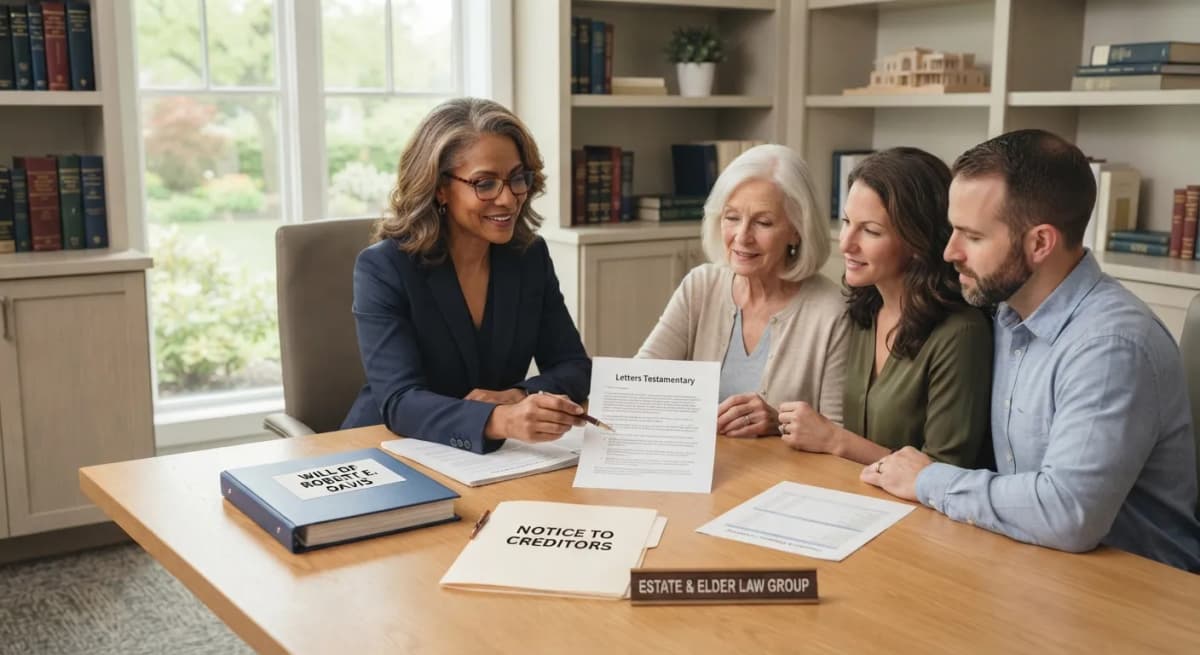
Probate is the legal process used to settle a person's estate after death. It can involve proving a will, appointing an executor or administrator, identifying and valuing assets, paying valid debts and expenses, addressing taxes, and distributing remaining property to heirs or beneficiaries. Not every asset necessarily goes through probate, and some estates may qualify for simplified procedures instead. Because probate laws and court procedures vary by state, understanding the basic steps can help families navigate the process and determine when professional legal assistance may be appropriate.
Probate is the legal process for handling certain property, debts, and financial affairs after someone dies. Depending on the circumstances, probate work may involve a court determining whether a will is valid, appointing a person to administer the estate, identifying and valuing assets, paying legitimate debts and expenses, and distributing property to the people legally entitled to receive it.
The person who died is commonly called the decedent, while the property and financial interests left behind are referred to as the estate. The person responsible for administering the estate may be called an executor, administrator, or more generally a personal representative, depending on the circumstances and state law.
Probate is often associated with a will, but having a will does not necessarily mean that every asset must go through probate. Similarly, dying without a will does not necessarily mean that every asset will pass through a lengthy court proceeding.
The first question is usually not simply, “Did the person have a will?” Instead, the family or personal representative generally needs to determine what property the deceased owned, how that property was titled, whether beneficiaries were designated, and which transfer process applies under state law.
That distinction is important because some assets can transfer outside probate.
For example, certain jointly owned assets, assets held in a trust, and accounts with valid beneficiary designations may pass according to their ownership or beneficiary arrangements rather than through the ordinary probate process. The exact treatment depends on the type of asset and applicable state law.
Probate serves several related purposes.
First, it can provide a legal process for determining who has authority to administer the estate.
Second, where a will exists, the probate court may determine whether the will is legally valid and should control the distribution of probate assets.
Third, probate provides a framework for identifying estate property and dealing with debts and claims.
Finally, the process allows remaining probate property to be transferred to beneficiaries or heirs according to the will or applicable intestacy law.
California Courts, for example, describes probate as the process used to transfer or inherit property after someone dies and explains that a court may appoint a personal representative to collect property, pay bills, and distribute what remains to people with a legal right to receive it.
New York Courts similarly explains that an executor generally handles an estate when there is a will, while an administrator generally handles an estate when there is no will.
The terminology and procedures vary, but the basic objective is similar: settle the deceased person's affairs and legally transfer property that requires estate administration.
Although probate procedures differ among states, the process commonly follows a sequence similar to the steps below.
The first step is determining whether the estate actually needs probate.
This is often more complicated than simply looking at the total value of everything the person owned.
Some property may be considered part of the estate but transfer through mechanisms that do not require ordinary probate. Other property may require a court proceeding.
Factors that can matter include:
Some states provide simplified procedures for smaller estates.
California Courts, for example, directs families to inventory and estimate estate property and then determine whether a simplified procedure such as a small-estate affidavit is available before proceeding with formal probate.
This means the family should not automatically begin a full probate case without first determining what procedure applies.
One of the most important concepts in estate administration is the difference between probate assets and non-probate assets.
Probate assets are generally assets that require the probate or estate-administration process to transfer ownership.
Non-probate assets may pass through another legal mechanism.
Examples can include:
The precise rules vary by state and asset type.
For example, New York's court guidance specifically distinguishes probate assets from non-probate property when estate assets are inventoried.
Because incorrectly assuming an asset is or is not subject to probate can create problems, families should verify the ownership and beneficiary arrangements for major assets.
If the deceased left a will, locating the original document is an important early step.
The will may identify:
Finding a copy can be useful, but some courts may require the original will or specific evidence concerning its absence.
California Courts, for example, instructs people who find an original will to deliver it to the court and refers to this process as “lodging” the will.
Other documents can also be important.
The family may need to locate:
Organizing these documents early can make the later stages of probate considerably easier.
Probate generally takes place in a court with jurisdiction over the deceased person's estate.
The appropriate court often depends on where the person was legally domiciled when they died, although additional proceedings can be necessary when the estate owns property in another state.
For example, California's formal probate guidance states that a probate case is generally filed in the county where the decedent lived, with a different procedure when a person lived outside California but owned California property.
The exact filing location depends on state law.
This becomes particularly important for people who:
An estate with property in multiple jurisdictions may require additional legal proceedings, sometimes called ancillary probate, depending on the circumstances.
If formal probate is required, someone must generally begin the court proceeding.
The person who files the initial petition may be called the petitioner.
The filing can request that the court:
The required forms and filing procedures vary by state.
For example, California's formal probate process involves filing a petition and supporting court forms to open the case. A hearing is then scheduled, and the court considers whether to appoint a personal representative.
New York similarly requires a petition for probate when a will is presented, while an administration proceeding is used when someone dies without a will.
The filing typically includes information about the deceased person, the will if one exists, potential heirs or beneficiaries, and an estimate or description of estate property.
Probate is not generally a private process in which the executor can simply decide what happens to everything.
People who may have legal interests in the estate can have rights to notice.
Depending on state law and the circumstances, notice may need to be provided to:
The exact notice requirements differ.
California, for example, requires notice concerning the probate hearing to specified family members and people who may have a right to receive part of the estate. Its formal probate procedure also includes publication requirements.
New York's probate procedures similarly require appropriate notice to people with legal interests, with specific rules governing waivers, citations, and service.
The purpose is to give interested people an opportunity to participate or object when the law gives them that right.
Once the required petition, notices, and other documents are properly handled, the court can appoint the person responsible for administering the estate.
If there is a valid will, that person is often the executor named in the will.
If there is no will, the court generally appoints an administrator according to the state's priority rules.
The broader term personal representative can refer to either.
California Courts explains that an executor is generally the person named in a will and appointed by the court, while an administrator is generally appointed when there is no will.
New York Courts likewise distinguishes between executors in probate proceedings and administrators in intestate administration proceedings.
The court may also require a bond in some cases.
The personal representative is a fiduciary, meaning the person has legal duties to act for the benefit of the estate and those entitled to it rather than using estate property for personal benefit.
After appointment, the personal representative receives formal authority to administer the estate.
The name of the document proving that authority differs by jurisdiction.
It may be called:
These documents can be important when dealing with banks, financial institutions, government agencies, property records, and other organizations.
The personal representative may need to provide certified copies of the appointment documents before an institution will recognize their authority.
At this point, the executor or administrator moves from being merely the person nominated to becoming the person legally responsible for administering the estate.
The personal representative must locate the assets belonging to the estate.
This can be one of the most time-consuming parts of probate.
Assets can include:
The representative should also protect estate property from loss or damage.
For example, if the deceased owned a vacant home, someone may need to arrange insurance, maintenance, utilities, security, and other practical matters while the estate is being administered.
The representative generally should not treat estate property as personal property.
New York Courts specifically states that fiduciaries are responsible for collecting and managing estate assets and that estate funds should be kept separately rather than mixed with personal funds.
After identifying the estate assets, the personal representative generally prepares an inventory.
The inventory may include:
Valuation can be important because estate administration, taxes, creditor issues, and distribution can depend on the value of property.
Some assets have an obvious value, such as a bank account.
Others may require professional appraisal.
A house, closely held business, valuable artwork, jewelry, or unusual personal property may require an appraisal or other valuation method.
The exact inventory requirements vary by state.
For example, New York's Surrogate's Court rules require an inventory of certain assets and specify categories of property that must be identified.
The representative should follow the court's instructions rather than relying on a generic national checklist.
An estate bank account may be appropriate or required for managing estate finances.
The purpose is to keep estate money separate from the personal finances of the executor or administrator.
Estate funds can then be used for authorized expenses and obligations.
Depending on the circumstances, estate income can include:
Keeping accurate financial records is extremely important.
The personal representative may eventually need to provide an accounting showing money received, expenses paid, assets distributed, and the remaining balance.
Probate is not only about distributing assets.
The deceased person's legitimate debts and financial obligations may also need to be addressed.
Potential debts can include:
The personal representative generally reviews claims and pays valid estate obligations according to the priority and procedures established by applicable law.
State law can establish specific procedures for notifying creditors and deadlines for filing claims.
That means families should not simply pay every bill that arrives without determining whether the claim is valid and how it should be handled through the estate.
California's formal probate guidance, for example, includes formal notice to creditors and payment of estate debts from estate funds when sufficient money is available.
Not every bill should necessarily be treated in exactly the same way.
The personal representative may need to determine:
Some debts are secured by property.
For example, a mortgage may be attached to a house.
The estate may need to continue dealing with the mortgage while determining whether the property will be sold, transferred, or retained by a beneficiary.
Estate administration therefore requires more than simply adding up bills and paying them in the order they arrive.
Taxes can be another important part of probate and estate administration.
Potential tax obligations can include:
Not every estate will owe estate tax.
Federal estate-tax rules have thresholds and exclusions, and state tax laws vary.
The personal representative should determine which tax filings apply based on the size and nature of the estate, the deceased person's circumstances, and the relevant tax laws.
California Courts, for example, notes that a personal representative may need to prepare a final personal income tax return and potentially an estate tax return when applicable.
Because tax consequences can be complex, an estate may benefit from advice from a qualified tax professional or attorney.
Sometimes an estate does not have enough liquid money to pay its expenses and debts.
The personal representative may therefore need to sell property.
A sale might also be necessary because the will directs a particular property to be sold or because beneficiaries agree to a particular distribution permitted by law.
Examples could include:
The representative must follow applicable law and the terms of the will.
In some jurisdictions, court approval may be required for certain transactions.
The representative should also document the transaction carefully.
Selling an estate asset for substantially less than fair value can potentially create disputes, particularly if beneficiaries believe the representative failed to protect the estate.
Not every probate case proceeds smoothly.
Someone may challenge the validity of a will or dispute the administration of the estate.
A will contest can involve allegations such as:
The legal grounds for challenging a will depend on state law.
A dispute can significantly increase the time and cost of probate.
The personal representative should not assume that every disagreement is a personal conflict that can simply be ignored. If a beneficiary or heir has a legal right to object, the court may need to resolve the issue.
Once debts, expenses, taxes, claims, and other necessary matters have been addressed, the remaining estate can generally be distributed.
If there is a valid will, probate assets are generally distributed according to its terms, subject to applicable law.
If there is no valid will, the estate is generally distributed under the state's intestacy laws.
Intestacy laws establish which relatives inherit and in what proportions.
The outcome can depend on whether the deceased had:
State intestacy laws vary significantly.
The personal representative should therefore not distribute property based simply on what seems fair to family members.
The legal entitlement should be determined under the will and applicable law.
In many probate proceedings, the personal representative must account for the estate's financial activity.
A final accounting may show:
The exact accounting requirements vary by state and by the type of probate proceeding.
California's formal probate process, for example, provides for a final report and accounting in connection with final distribution, subject to circumstances in which beneficiaries may waive an accounting.
Good recordkeeping throughout the probate process makes this stage easier.
After the court approves the final distribution when required, the personal representative can transfer the remaining assets to beneficiaries or heirs.
Distribution may involve:
Documentation is important.
Beneficiaries may need to sign receipts, releases, or acknowledgments depending on state law and the circumstances.
The personal representative should keep records showing exactly what was distributed and to whom.
The final step is formally closing the estate.
The procedure differs among states.
A court may require:
The estate should not necessarily be considered officially closed merely because all the money appears to have been distributed.
For example, New York court materials explain that an estate is not considered closed simply because its assets have been distributed; proper steps must still be taken to close the proceeding.
The representative should follow the specific closing procedure required by the court handling the estate.
There is no single nationwide probate timeline.
A straightforward estate may move relatively quickly, particularly if there are few assets, no disputes, and simplified procedures are available.
A more complicated estate can take substantially longer.
Factors that can extend probate include:
The time required also depends on the state's court procedures.
For this reason, anyone planning an estate or administering one should be cautious about promises that probate will always take a specific number of months.
Probate costs vary considerably.
Possible expenses include:
Some fees are paid initially by the personal representative and later reimbursed from estate assets.
California Courts, for example, notes that many probate fees are ultimately paid from the estate, although a personal representative may have to pay certain costs upfront and receive reimbursement later.
The exact cost structure depends on the jurisdiction, estate size, complexity, and whether disputes arise.
No.
Whether an estate requires probate depends on the assets, ownership arrangements, beneficiary designations, trusts, and state law.
Some states also provide simplified procedures for qualifying estates.
A small estate procedure may allow certain property to be transferred without going through the full formal probate process.
The eligibility threshold and requirements vary by state.
California, for example, provides a small-estate process for qualifying property under state law.
New York also provides a voluntary-administration procedure for certain qualifying small estates.
These examples show why the phrase “small estate” does not have one universal dollar threshold across the United States.
When a person dies without a valid will, they are generally described as having died intestate.
The estate is then distributed under state intestacy laws rather than according to instructions in a will.
The court may appoint an administrator or other personal representative.
The administrator typically performs many of the same practical duties as an executor:
The biggest difference is generally how the remaining property is distributed.
With a valid will, the will generally provides the distribution instructions.
Without a valid will, state intestacy law determines the heirs.
Not necessarily.
A common misconception is that writing a will means probate is unnecessary.
A will can provide important instructions about the distribution of property, but it generally does not automatically transfer every probate asset outside the probate process.
California Courts specifically notes that an estate may still need to go through probate even when the deceased person had a will.
A will is therefore better understood as a document that directs the distribution of property that is subject to it, rather than as an automatic substitute for the probate process.
Other estate-planning tools, such as trusts and beneficiary designations, may affect whether particular assets pass through probate.
The terminology varies by jurisdiction, but probate and estate administration are closely related concepts.
Probate often refers specifically to the court process of proving and accepting a will and administering property subject to probate.
Estate administration is the broader process of settling the deceased person's financial affairs.
When someone dies with a will, the person appointed under the will is commonly called an executor.
When someone dies without a will, the person appointed by the court is commonly called an administrator.
Both can have similar responsibilities.
New York Courts describes executors and administrators as fiduciaries with responsibilities that include collecting assets, paying bills and taxes, and transferring property according to the will or applicable intestacy law.
An executor is responsible for carrying out the deceased person's wishes as expressed in a valid will, subject to applicable law and court supervision.
Typical duties may include:
The executor is not simply a person who gets to decide how property should be distributed.
The executor is a fiduciary with duties to the estate and its beneficiaries.
Generally, an executor cannot simply take estate property for personal use because they were appointed to administer the estate.
Estate property belongs to the estate until it is properly distributed or otherwise disposed of under applicable law.
An executor may be entitled to compensation in some jurisdictions, and an executor who is also a beneficiary may receive property under the will.
Those situations are different from treating estate assets as personal property without authorization.
Fiduciary duties are serious.
New York Courts explains that fiduciaries have a duty to act faithfully toward the estate and not place their own interests ahead of their responsibilities.
Sometimes.
Estate planning can be structured to allow certain assets to pass outside probate.
Potential tools include:
However, avoiding probate is not always the primary objective of estate planning.
A strategy that works for one person may be inappropriate for another.
The estate's size, family structure, property location, tax situation, privacy concerns, and state law can all matter.
Additionally, putting an asset into a trust or adding a beneficiary does not automatically make the arrangement correct. Documents and account titles need to be properly established and maintained.
In some jurisdictions and circumstances, a person can handle probate without hiring an attorney.
Courts may provide forms, instructions, and self-help resources.
However, formal probate can become complicated quickly.
Legal assistance may be particularly useful when an estate involves:
California Courts notes that a personal representative can sometimes proceed without a lawyer but may seek legal advice when questions arise.
The right choice depends on the complexity of the estate and the rules of the relevant jurisdiction.
Probate mistakes can create unnecessary delays, expenses, or disputes.
Estate funds should generally be kept separate from personal funds.
Mixing the two can make accounting difficult and potentially create fiduciary problems.
Beneficiaries may be eager to receive their inheritance, but distributing assets before debts, taxes, creditor claims, and other obligations are addressed can create serious problems.
A representative should not ignore creditor claims or assume that every debt disappears at death.
The estate may remain responsible for valid obligations.
Some assets are easy to find.
Others may be hidden in old accounts, business interests, investment accounts, digital platforms, or property records.
A thorough asset search is important.
Probate involves deadlines.
Missing a deadline for a filing, creditor notice, tax return, or court response can delay the process or create legal complications.
A will generally controls property that passes under the will, but certain assets may pass through beneficiary designations, joint ownership, trusts, or other arrangements.
The personal representative should determine whether court approval or another legal procedure is required before selling estate property.
Every significant estate transaction should be documented.
Good records can help demonstrate that the representative acted properly and can make the final accounting much easier.

Probate is the legal process used to settle certain aspects of a person's estate after death. Although the exact procedure differs by state, the process commonly involves determining whether probate is necessary, locating and filing the will when applicable, opening a court case, appointing a personal representative, identifying and valuing assets, addressing creditor claims and taxes, distributing remaining property, and formally closing the estate.
The process is not necessarily required for every asset or every estate. Property held through certain trusts, joint ownership arrangements, beneficiary designations, and other transfer mechanisms may pass outside probate. Smaller estates may also qualify for simplified procedures depending on state law.
For families dealing with probate, one of the most important principles is to avoid assuming that rules from another state apply to their situation. Court forms, deadlines, creditor procedures, executor powers, small-estate thresholds, accounting requirements, and distribution rules can all vary by jurisdiction.
An executor or administrator also has important fiduciary responsibilities. Estate property should be protected, estate funds should be kept separate from personal funds, valid debts and expenses should be addressed, and distributions should be made according to the will or applicable law.
If the estate is straightforward, court self-help resources may provide useful procedural information. If the estate involves significant assets, disputes, multiple states, tax questions, business interests, or uncertainty about the deceased person's wishes, consulting a qualified probate or estate attorney can help the personal representative understand the obligations that apply.
Probate can seem complicated at first, but understanding the process step by step makes the major responsibilities easier to identify: determine what needs probate, establish legal authority, protect and value the estate, resolve debts and taxes, distribute the remaining property correctly, and complete the required closing process.

Written by
BeastBeast is a seasoned legal content creator and law research specialist with 15+ years of experience in legal writing, legal research, and publishing educational law content. Specializing in Personal Injury, Family, Business, Immigration, Criminal, Tax, and Real Estate Law, Beast creates accurate, well-researched, and SEO-optimized legal guides that help readers understand complex legal topics with confidence. Every article is written with a focus on accuracy, trust, and Google's E-E-A-T guidelines, making Jurnza.com a reliable source for legal information and legal services.
