Document Generators
Injury & Compensation
Fees & Support
Deadlines & Filing
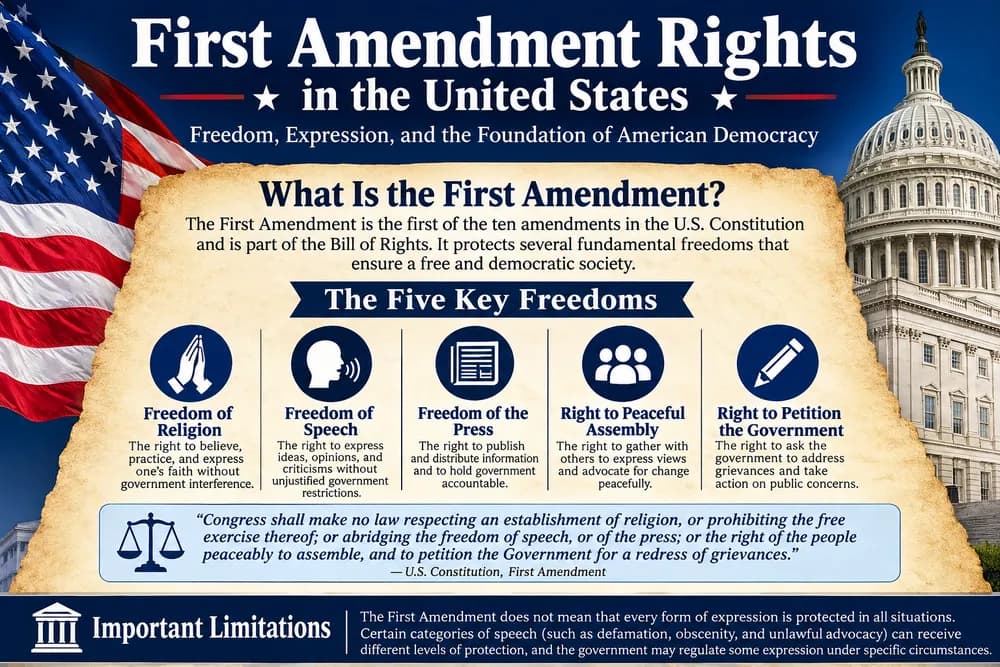
First Amendment is one of the most important protections in the United States Constitution. It is part of the Bill of Rights and protects several fundamental freedoms that play a central role in American democracy. These include freedom of religion, freedom of speech, freedom of the press, the right to peacefully assemble, and the right to petition the government for a redress of grievances.
The First Amendment is often discussed simply as the constitutional protection of "free speech," but its scope is much broader. It protects several interconnected freedoms that allow individuals to express ideas, criticize government officials, practice religion, publish information, organize peacefully, and ask the government to address problems.
At the same time, the First Amendment does not mean that every form of expression is protected in every situation. Constitutional law has developed through decades of Supreme Court decisions that determine when the government may regulate speech and when restrictions violate the Constitution. Certain categories of expression, such as defamation, obscenity, and some forms of unlawful advocacy, can receive different levels of constitutional protection.
Understanding the First Amendment therefore requires more than simply saying that Americans have "freedom of speech." The amendment establishes important limits on governmental power while also operating within a broader legal system.
This article explains the history, meaning, major protections, limitations, and practical importance of the First Amendment in the United States.
The First Amendment is the first of the ten amendments that make up the Bill of Rights. It protects several fundamental liberties from government interference.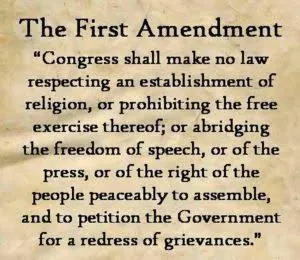
The amendment addresses five major areas:
The constitutional text states that Congress may not make laws establishing religion, prohibiting the free exercise of religion, abridging freedom of speech or press, or preventing people from peacefully assembling and petitioning the government.
Although the wording refers specifically to Congress, First Amendment protections have become applicable to state and local governments through constitutional doctrine. This means that the amendment has an enormous effect on government activity throughout the United States.
The basic principle behind the First Amendment is that government generally cannot control public debate simply because officials dislike a particular idea, opinion, viewpoint, or message. The Supreme Court has repeatedly emphasized the importance of preventing government from suppressing expression because of its content.
The First Amendment was created in the aftermath of the American Revolution and the adoption of the Constitution. Many Americans were concerned about excessive governmental power and wanted stronger guarantees protecting individual liberty.
The Bill of Rights was proposed in 1789. James Madison played a major role in drafting the amendments. His original proposal concerning speech and press contained language protecting the people's ability to speak, write, and publish their opinions.
The final First Amendment was shorter than Madison's original proposal, but it established several broad protections.
The historical development of freedom of expression was influenced by earlier conflicts over government censorship. In England, for example, systems requiring government approval before publication had restricted the ability of printers and publishers to distribute information. The American constitutional tradition developed a strong opposition to this type of prior governmental censorship.
This history helps explain why freedom of the press and freedom of expression became important parts of American constitutional law.
Freedom of speech is probably the most recognizable protection associated with the First Amendment.
It generally protects people's ability to express ideas, opinions, political views, criticisms, and other forms of expression from unjustified government restrictions. The protection can apply to spoken words, written material, artistic expression, symbolic conduct, demonstrations, and other forms of communication.
The government generally cannot restrict speech simply because officials disagree with the speaker's viewpoint. The Supreme Court has described the core principle as preventing government from suppressing expression because of its message, ideas, subject matter, or content.
This principle is particularly important in political discussions.
For example, citizens may criticize elected officials, oppose government policies, support political candidates, advocate for changes in law, or protest government decisions. A democratic society depends on the ability of people to debate these issues without fear that the government will punish them merely for expressing unpopular opinions.
However, freedom of speech is not unlimited.
The legal system recognizes that certain categories of expression may be regulated under specific circumstances. Defamation, obscenity, fighting words, and advocacy of illegal action are examples of areas in which constitutional protection can be limited or treated differently.
The exact constitutional analysis depends on the circumstances, the type of speech involved, and the government's reason for regulating it.
Political expression receives particularly strong First Amendment protection.
The ability to criticize political leaders is fundamental to democratic government. If government officials could punish citizens simply for criticizing them, public debate could become meaningless.
Political speech can take many forms. A person might write an article, publish a video, participate in a protest, create political artwork, distribute pamphlets, post an opinion online, or speak at a public meeting.
The First Amendment generally prevents government from suppressing political expression simply because officials dislike its viewpoint.
This protection also extends beyond traditional spoken words. Constitutional law recognizes forms of expressive conduct, sometimes referred to as symbolic speech. Examples can include demonstrations, picketing, marching, distributing leaflets, and other conduct intended to communicate a message.
The First Amendment also protects religious liberty.
Its religious protections are commonly discussed through two clauses: the Establishment Clause and the Free Exercise Clause.
The Establishment Clause addresses government involvement with religion and prevents the government from establishing or officially favoring religion in ways prohibited by the Constitution.
The Free Exercise Clause protects religious practice. It prevents government from prohibiting the free exercise of religion, although religious conduct is not necessarily immune from every generally applicable law.
The Supreme Court has distinguished between religious belief and religious conduct. The freedom to hold beliefs is extremely strong, while government may sometimes regulate conduct depending on the circumstances and the applicable constitutional standards.
These protections are important because the United States contains people with many different religious beliefs as well as people who do not follow a religion.
Religious freedom allows individuals to practice their faith without government establishing an official religion or improperly interfering with protected religious practices.
The First Amendment separately protects freedom of the press.
A free press plays an important role in informing the public and holding government institutions accountable. Newspapers, magazines, broadcasters, websites, journalists, and other media organizations can investigate government activity and publish information about public affairs.
The Supreme Court has historically been particularly skeptical of government systems that prevent publication before material is released. This concept is known as prior restraint.
A prior restraint occurs when the government attempts to prevent speech or publication before it happens. Courts have treated prior restraints as highly constitutionally suspect, placing a heavy burden on the government to justify them.
The importance of press freedom does not mean that journalists can never face legal consequences. Laws involving defamation, confidentiality, national security, and other subjects can create complicated constitutional questions. However, government censorship of publications is generally subjected to serious constitutional scrutiny.
The First Amendment also protects the right of people to peacefully assemble.
Assembly allows individuals to come together to express shared views, organize around political or social issues, and participate in public demonstrations.
A peaceful protest is one common example.
People may organize demonstrations to support legislation, oppose government policies, raise awareness about social problems, or advocate for political change. The ability to gather with others makes it possible for individuals to amplify their voices.
The right is not absolute, however. Governments can impose certain reasonable regulations concerning issues such as public safety, traffic, and the use of public spaces, provided those regulations comply with constitutional requirements.
The distinction between peaceful assembly and unlawful conduct is important. The First Amendment protects peaceful expressive activity, but it does not automatically protect violence or other independent criminal conduct.
The fifth major protection in the First Amendment is the right to petition the government for a redress of grievances.
This means people have a constitutional right to ask government officials to address problems and change policies.
Petitioning can take many forms. Citizens can contact elected representatives, submit petitions, participate in public hearings, communicate with government agencies, join advocacy organizations, or otherwise request government action.
This right is closely connected to democracy. Government exists to serve the public, and citizens need mechanisms for communicating their concerns.
The right to petition also provides a constitutional basis for many forms of political participation.
A central purpose of the First Amendment is to limit government power.
The government performs many legitimate functions, and some government regulations inevitably affect expression. For example, governments may need rules concerning public schools, prisons, workplaces, elections, public property, and public safety.
The constitutional question is often whether a particular restriction is justified and whether it improperly targets protected expression.
The Supreme Court has recognized that government has greater authority to regulate speech in certain special contexts. For example, government may have legitimate interests in operating schools and prisons and maintaining effective government workplaces. However, restrictions can still violate the First Amendment if they go too far.
This is why First Amendment cases frequently require courts to examine the exact circumstances surrounding a restriction.
One of the most important concepts in First Amendment law is the difference between content-based and content-neutral regulations.
A content-based restriction regulates speech because of what the speech says.
For example, imagine that a government regulation allows citizens to criticize a particular policy but prohibits criticism of another policy. The government would be distinguishing between messages based on their content.
Such restrictions generally receive serious constitutional scrutiny because the First Amendment strongly disfavors government control over ideas and viewpoints.
The Supreme Court has stated that government generally cannot restrict expression because of its message, ideas, subject matter, or content.
Not every regulation affecting speech is necessarily unconstitutional.
A government regulation may sometimes address the manner, location, or circumstances of expression rather than the message itself.
For example, a city may have legitimate reasons for regulating the use of public streets during certain events. It might need to protect emergency access or prevent serious disruption.
The constitutional analysis can depend on whether the rule applies regardless of viewpoint and whether it leaves adequate opportunities for expression.
The government cannot simply disguise censorship as a neutral regulation. Courts examine the actual purpose and operation of laws to determine whether they improperly target protected expression.
Prior restraint is another major First Amendment concept.
Instead of punishing speech after it occurs, prior restraint attempts to stop publication or expression before it happens.
American constitutional law has traditionally viewed prior restraints with strong suspicion. The Supreme Court has stated that systems imposing prior restraints carry a heavy presumption against constitutional validity.
This principle is particularly significant for freedom of the press.
Imagine a newspaper preparing to publish an article criticizing a government agency. If the government attempted to obtain an order preventing publication before the article appeared, that could raise a serious prior-restraint issue.
However, the existence of a strong presumption does not mean that every conceivable prior restraint is automatically unconstitutional. Courts examine the specific circumstances and the government's justification.
Speech does not always require spoken or written words.
People sometimes communicate ideas through conduct, symbols, clothing, demonstrations, artwork, or other expressive activities. Constitutional law can protect some of these actions as symbolic or expressive speech.
Examples historically discussed in First Amendment cases include marching, picketing, distributing leaflets, and certain forms of symbolic protest.
This concept is important because communication is not limited to conversations.
A protester holding a sign, an artist creating political artwork, or a person participating in a demonstration may be communicating an idea even without delivering a traditional speech.
Courts therefore sometimes have to determine whether particular conduct contains a sufficiently expressive component to receive constitutional protection.
The First Amendment can also protect people from being forced to communicate certain messages.
Compelled speech occurs when the government requires a person or organization to express a message.
The Supreme Court has recognized that forcing someone to communicate a message can itself raise First Amendment concerns because the government is interfering with the speaker's ability to control their own expression.
This principle demonstrates that freedom of expression is not simply the freedom to speak.
In certain circumstances, it can also involve the freedom not to communicate a government-required message.
The exact constitutional rules depend heavily on the type of requirement and the governmental interest involved.
A common misunderstanding is that the First Amendment protects every statement a person can make.
It does not.
Certain categories of expression have historically received limited or no constitutional protection under particular circumstances. Examples include some forms of defamation, obscenity, fighting words, and advocacy of unlawful conduct.
This does not mean that a government can simply label speech as "offensive" and ban it.
The constitutional analysis depends on established legal categories and judicial standards.
For example, an offensive political opinion can still receive strong First Amendment protection even when many people strongly disagree with it.
The central issue is often whether the government is regulating protected expression because of its content or whether it is addressing conduct or a legally recognized unprotected category.
Defamation generally involves false statements of fact that harm another person's reputation.
First Amendment law creates important protections for expression concerning public officials and public figures. This is partly because allowing easy lawsuits over political criticism could discourage people from participating in public debate.
The constitutional relationship between defamation law and freedom of speech is therefore complicated.
The law attempts to balance two important interests: protecting individuals from genuinely harmful false statements and protecting open discussion of public issues.
The existence of defamation law demonstrates why "freedom of speech" does not mean that people have an unlimited constitutional right to say anything without legal consequences.
Modern technology has created new questions about freedom of expression.
People can now communicate instantly through social media, websites, video platforms, messaging services, and online forums. A person with a smartphone can potentially reach a global audience without owning a newspaper or television station.
This has made the principles of free expression more visible than ever.
However, an important distinction must be made between government censorship and decisions made by private companies.
The First Amendment generally restricts government action. It does not automatically require a private website or social-media company to publish every user's content.
For example, if a private platform removes a post under its own rules, that situation is not automatically a First Amendment violation simply because the user disagrees with the decision.
Constitutional free-speech law is primarily concerned with government restrictions.
This distinction is important when discussing online censorship because people often use the term "First Amendment violation" to describe private moderation decisions that may not involve government action.
Students also have First Amendment rights, although schools have certain authority to maintain an educational environment.
The Supreme Court has recognized constitutional protection for some forms of student expression. For example, the Court's decision in Tinker v. Des Moines involved students who wore black armbands to protest the Vietnam War. The Court concluded that the students' expression was protected under the circumstances.
However, students do not have an unlimited constitutional right to say or do anything at school.
Schools can maintain rules necessary for education, safety, and orderly operations. The precise constitutional limits depend on the circumstances and the type of expression involved.
This illustrates a broader principle of First Amendment law: constitutional rights can operate differently depending on the governmental environment.
Government employees can also have First Amendment interests, but their rights can be affected by their professional responsibilities.
A government employee may speak about matters of public concern, but the government also has legitimate interests in operating effectively.
Courts therefore analyze whether an employee is speaking as a private citizen or as part of their official duties and examine the government's interests.
This area demonstrates that First Amendment law is not simply a question of whether someone works for the government. The nature of the speech, the employee's role, and the circumstances can all matter.
Democracy depends on the free exchange of ideas.
Citizens need to be able to criticize leaders, discuss political policies, support candidates, oppose legislation, investigate government conduct, and organize with other people.
Without meaningful protection for these activities, elections and democratic institutions could become less effective.
The First Amendment therefore serves as more than a protection for individual expression. It also helps maintain an environment in which political debate can occur.
A government that controls which ideas citizens are allowed to express could potentially prevent criticism and discourage opposition.
The constitutional protection of speech helps reduce this danger.
One of the most difficult aspects of free-speech law is that constitutional protection can extend to opinions that many people strongly dislike.
If government could prohibit every unpopular opinion, freedom of speech would provide little protection.
The purpose of constitutional free-speech principles is therefore not simply to protect ideas that everyone accepts. Protection becomes especially important when government attempts to suppress controversial viewpoints.
This does not mean that individuals must agree with offensive or unpopular opinions.
People are free to criticize speech, debate it, ignore it, or respond with their own expression. The constitutional question is generally whether government has unlawfully restricted the expression.
Political protests are a practical example of several First Amendment rights working together.
A protest may involve speech, symbolic expression, assembly, press activity, and petitioning the government.
Participants may hold signs, give speeches, distribute literature, march together, record events, and request changes in government policy.
The government can sometimes impose reasonable rules governing demonstrations, particularly when necessary to protect public safety or manage public spaces. But those rules cannot simply be used as a pretext for suppressing particular viewpoints.
This balance between public order and constitutional freedom is a recurring issue in First Amendment law.
When a First Amendment dispute reaches court, judges may examine several questions.
First, the court may determine whether the government actually caused the restriction.
Second, it may identify what type of expression is involved.
Third, the court may examine whether the law is based on the content or viewpoint of the expression.
Fourth, the court may consider the government's justification.
Finally, the court applies the appropriate constitutional test to determine whether the restriction is permissible.
The applicable standard can vary depending on the type of speech, the governmental setting, and the nature of the regulation.
This is why two cases involving "free speech" can produce different legal outcomes.
The Supreme Court has developed First Amendment doctrine through numerous cases.
One important line of cases concerns prior restraint and freedom of the press. The Court has repeatedly treated government attempts to prevent publication in advance with serious constitutional skepticism.
Another major area involves political and expressive speech. Courts have recognized that government generally cannot suppress expression simply because it disagrees with the ideas being communicated.
Cases involving symbolic speech have also established that expression can occur through conduct rather than traditional spoken or written language.
Religious-liberty cases have developed separate doctrines concerning government involvement with religion and restrictions on religious exercise.
Together, these decisions form a large body of constitutional law that continues to evolve.
Constitutional rights come with an important social context.
A person exercising freedom of speech should understand that constitutional protection does not necessarily prevent all consequences of their words.
For example, a private employer may have its own policies, a private platform may have content rules, and individuals may respond to speech with criticism or disagreement.
The First Amendment primarily limits government power.
This means that people should distinguish between government punishment and private consequences.
At the same time, individuals should understand the limits of protected expression. Freedom of speech does not provide a general constitutional defense against every criminal law or civil claim.
Understanding these distinctions helps prevent common misconceptions about the First Amendment.
The First Amendment was adopted more than two centuries ago, but its principles remain relevant because the fundamental problem it addresses has not disappeared: the relationship between government power and individual expression.
Technology has changed dramatically since the eighteenth century.
People now communicate through social networks, podcasts, livestreams, blogs, websites, digital newspapers, video platforms, and countless other technologies.
Yet the underlying constitutional question remains similar: when may government interfere with expression, and when does that interference violate constitutional freedom?
Courts continue to apply First Amendment principles to new circumstances.
The rise of digital communication has made questions concerning speech, press freedom, privacy, political communication, and government regulation increasingly significant.
The First Amendment is a cornerstone of constitutional law in the United States. It protects freedom of religion, speech, press, peaceful assembly, and petition, creating important limits on government power.
Its protection of free expression allows people to debate political issues, criticize government officials, organize protests, publish information, express controversial opinions, and participate in democratic life.
However, the First Amendment is not an unlimited license to engage in every form of conduct or expression without legal consequences. Certain categories of speech receive different levels of constitutional protection, and governments can sometimes regulate expression under specific circumstances.
The distinction between government restrictions and private decisions is also essential. The First Amendment primarily protects people from government interference rather than guaranteeing access to every private platform or organization.
Perhaps the most important feature of the First Amendment is its protection of open debate. Democracy requires citizens to exchange ideas, challenge authority, criticize policies, and organize around shared goals. The constitutional protection of these activities helps ensure that political power is not able to control public discussion simply by suppressing ideas it dislikes.
For that reason, the First Amendment remains one of the most significant parts of American constitutional law. Its principles affect everyday life, political participation, journalism, education, religion, protests, and modern digital communication.
Understanding the First Amendment is therefore not only important for lawyers and legal professionals. It is valuable for anyone who wants to understand how individual liberty and government power interact in the United States.
