Deadlines & Filing
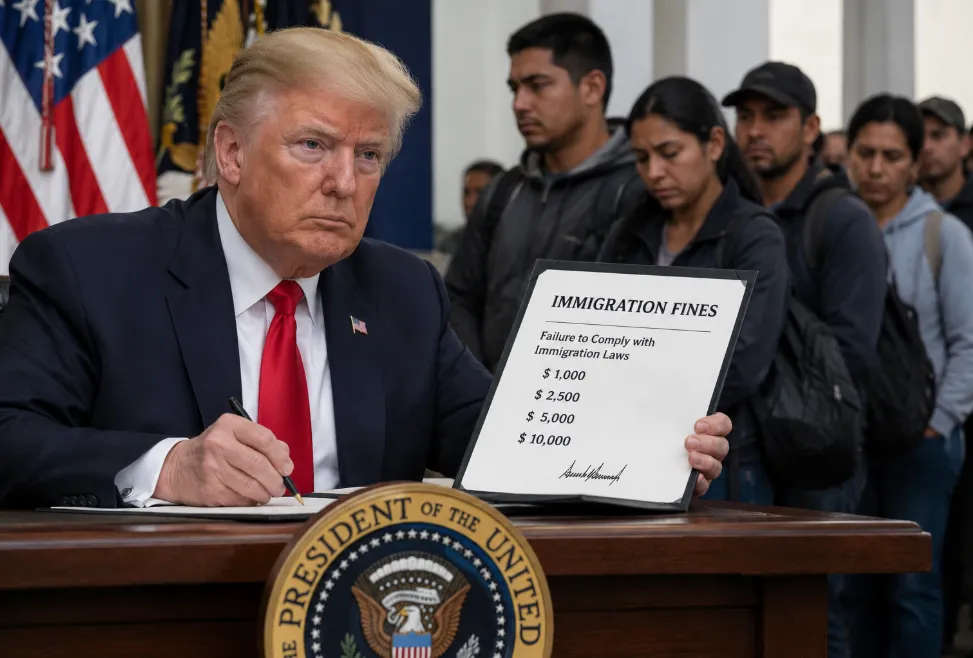
Can the U.S. government fine an immigrant up to $1.8 million for failing to leave the country after a deportation order? A new federal court ruling is challenging the Trump administration's use of $998-per-day civil immigration penalties, raising major questions about administrative law, executive power, due process, statutory authority, and government enforcement procedures. This guide explains how the fines work, why the court blocked the challenged policy, what the Administrative Procedure Act requires, how notice-and-comment rulemaking matters, what happens next, and what immigrants facing government penalties should know.
A federal judge has blocked a Trump administration policy that imposed civil fine of up to $1.8 million on immigrants who failed to leave the United States after receiving final deportation orders.
The ruling, issued by U.S. District Judge George O'Toole in Boston on October 5, 2026, found that the administration's implementation of the fines was unlawful. The decision came in a class-action lawsuit brought by two immigrants who had been assessed penalties and the Immigrant Legal Resource Center.
The dispute involves a little-known immigration penalty that can become enormous when applied over a long period. Under the administration's approach, certain immigrants could be fined $998 for each day they remained in the United States after a final removal order. The government applied some penalties retroactively for as long as five years, potentially producing a maximum fine of approximately $1.8 million.
According to figures reported by the Department of Homeland Security in July, more than 103,000 fines had been issued, representing approximately $84 billion in penalties.
The government argued that Congress had authorized civil penalties for certain failures to depart under federal immigration law. The challengers, however, argued that the administration was imposing those penalties through unlawful procedures and without properly determining whether individual immigrants had willfully or voluntarily failed to depart.
Judge O'Toole sided with the challengers and concluded that the government's process violated the Administrative Procedure Act.
The decision raises important questions about executive power and immigration enforcement.
Can an administration impose massive financial penalties under an existing statute without following additional rulemaking procedures? What procedural protections must the government provide before imposing a civil penalty? Can an agency use standardized forms without explaining the specific facts supporting each penalty? And how much discretion does the executive branch have when Congress has authorized a penalty but has not specifically directed the government to implement it in the manner being used?
This guide explains the legal battle, how immigration fines work, why the court blocked the policy, what the Administrative Procedure Act has to do with the case, what due process means in this context, and what could happen next.
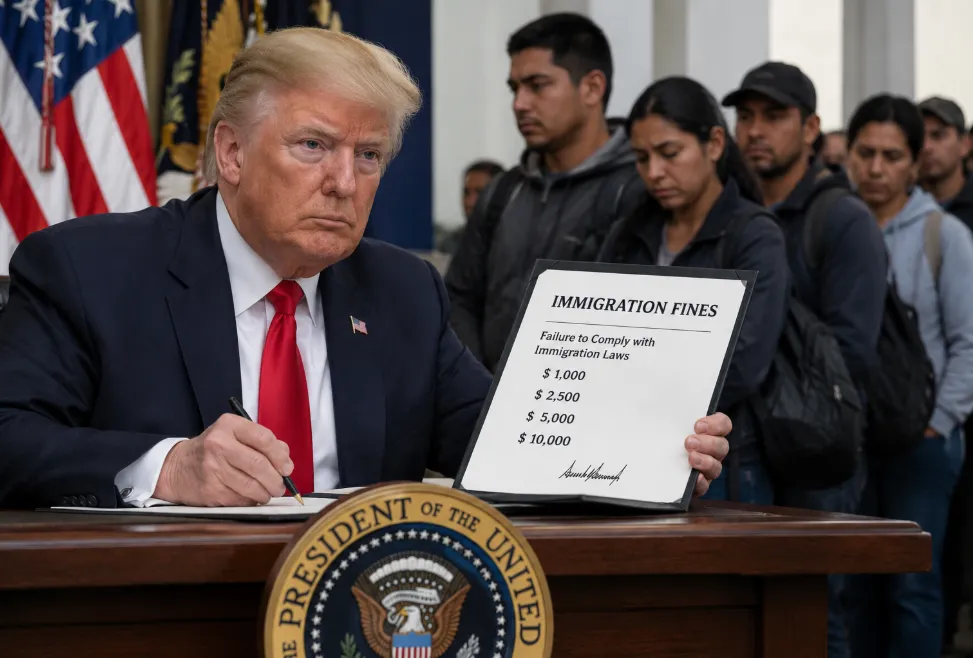
Federal immigration law allows the government to impose certain civil monetary penalties on people who fail to depart the United States after receiving a final order of removal.
These penalties are separate from criminal punishment.
A civil immigration fine is generally designed as a financial consequence rather than a criminal sentence. The government's authority to impose such penalties comes from federal immigration statutes enacted by Congress.
The existence of statutory authority, however, does not necessarily mean that the executive branch can impose a penalty in any manner it chooses.
Federal agencies must generally operate within the authority granted by Congress and comply with applicable procedural requirements.
That distinction became central to the recent lawsuit.
The Trump administration revived aggressive use of these penalties during its second term. The government began assessing fines at a rate of $998 per day for certain immigrants who failed to depart following removal orders.
Because the penalties could be applied retroactively for years, the amount owed could become extraordinarily large.
A person who accumulated the maximum penalty could face a liability approaching $1.8 million.
The scale of the penalties is one reason the case attracted significant attention.
The size of the penalty results from the daily assessment being multiplied over a lengthy period.
At $998 per day, even a relatively short period can produce a substantial financial obligation.
Over several months, the amount can reach hundreds of thousands of dollars.
Over several years, it can approach or exceed a million dollars.
The administration's policy allowed certain fines to be imposed retroactively for as much as five years. That meant the government could potentially assess a very large penalty based on conduct that had occurred years earlier.
The challengers argued that the government's process made the situation particularly problematic because immigrants could receive enormous financial penalties without adequate individualized explanation of why the penalty applied to them.
The judge agreed that the procedures used by the government were unlawful.
This is one of the most important distinctions in the case.
The court did not simply decide that the federal government has no statutory authority to impose immigration-related civil penalties.
Congress authorized certain civil penalties under the Illegal Immigration Reform and Immigrant Responsibility Act of 1996.
The problem identified by the court involved how the administration implemented and assessed those penalties.
That distinction matters because an agency can have legal authority to regulate an area while still violating administrative law when exercising that authority.
Think of it this way:
Congress can authorize a government agency to impose a particular type of penalty, but the agency may still have to follow procedures required by federal law before deciding how that authority will be applied.
The recent ruling focused heavily on that procedural problem.
Judge George O'Toole concluded that the administration's fine-related practices were unlawful.
One issue concerned the forms used to impose the penalties.
According to the court's ruling as described in reporting on the decision, the government used standardized or boilerplate forms that did not adequately explain the specific facts supporting an individual's penalty.
The challengers argued that the government was not independently determining whether each person's failure to leave was actually voluntary or willful.
That mattered because the statutory penalty depends on particular circumstances rather than simply the fact that a person remained in the country.
Judge O'Toole found that the government's approach did not satisfy the requirements of the Administrative Procedure Act.
He also concluded that the administration had improperly changed its procedures for imposing the fines without first providing the public with the opportunity to comment required by federal administrative law.
The court therefore blocked the challenged penalty-related policies.
The Administrative Procedure Act, commonly called the APA, is one of the most important laws governing federal agencies.
Congress enacted the APA to establish procedures for federal administrative agencies and to provide a framework for judicial review of agency actions.
The law affects agencies across the federal government.
It can govern areas involving:
The APA does not prevent agencies from creating or enforcing regulations.
Instead, it establishes legal requirements for how agencies exercise their authority.
One important part of administrative law involves rulemaking.
When an agency creates or changes certain rules that affect the public, it may have to provide notice and an opportunity for public comment before the rule becomes effective.
That process is often called notice-and-comment rulemaking.
The purpose is to give affected people, businesses, organizations, and other members of the public an opportunity to provide information and arguments before the agency adopts the rule.
The Trump administration and its challengers disagreed about whether the government's streamlined process for imposing the immigration fines amounted to a change that required formal rulemaking procedures.
The administration had implemented a process that shortened the time and procedures for challenging penalties and eliminated a 30-day notice period that had previously been part of the process.
The challengers argued that the government could not make such a significant procedural change without giving the public an opportunity to comment.
Judge O'Toole agreed.
The court concluded that the administration failed to follow required rulemaking procedures before adopting the new process.
This is significant because it demonstrates an important limitation on executive agencies.
An agency may have substantial authority, but it cannot necessarily change the rules governing that authority whenever it wants.
Administrative procedures can matter just as much as the underlying statute.
Due process is another important legal principle in disputes involving government penalties.
The Fifth Amendment provides that the federal government may not deprive a person of life, liberty, or property without due process of law.
A massive financial penalty is a deprivation of property.
That does not mean the government can never impose a fine.
Instead, due process generally requires appropriate procedures before the government imposes certain types of penalties.
Depending on the circumstances, those procedures can include:
The exact requirements vary depending on the type of government action and the interests involved.
In the immigration-fine litigation, the challengers argued that the government's procedures did not provide adequate individualized consideration.
The court's ruling focused on administrative-law violations, but the broader dispute illustrates why procedural protections are important when the government seeks to impose enormous financial obligations.
One of the major issues raised by the lawsuit was whether the government properly determined that an individual's failure to depart was voluntary or willful.
This is important because simply remaining in the United States does not necessarily answer every legal question surrounding a penalty.
People can face complicated circumstances.
For example, an individual may claim that departure was not practically possible because of:
The precise legal significance of these circumstances depends on the applicable immigration law.
The challengers argued that the government's use of standardized forms did not adequately establish the individualized facts needed to justify the penalties.
That raised a basic administrative-law question:
Can an agency impose an enormous penalty without specifically explaining why the individual person's conduct satisfies the statutory requirements?
The judge concluded that the government's process was inadequate.
The administration imposed civil penalties of $998 per day on certain immigrants who failed to depart after receiving final removal orders.
Because the amount was assessed daily, the financial exposure could grow rapidly.
For example, a penalty continuing for:
These figures illustrate why the litigation was not merely about a technical administrative procedure.
For people with limited financial resources, a six-figure or seven-figure government debt can have life-changing consequences.
Judge O'Toole specifically expressed concern that collecting the fines could push the plaintiffs into insolvency.
According to figures provided by the Department of Homeland Security in July, the government had issued more than 103,000 fines since President Donald Trump returned to office.
The total amount of those penalties was reported at approximately $84 billion.
That number represents assessed penalties, not necessarily money that the government has successfully collected.
The distinction is important.
A government agency can assess a civil penalty without ultimately collecting the entire amount.
Some penalties may be challenged, reduced, suspended, invalidated, or otherwise affected by litigation or administrative procedures.
The recent federal court ruling could therefore have consequences beyond the two named plaintiffs.
Because the case was brought as a class action, the court's ruling may affect a broader group of people covered by the litigation.
Judge O'Toole noted that the plaintiffs were already in economically precarious circumstances.
A penalty approaching $1.8 million would obviously be extraordinary for most individuals.
The court concluded that allowing the government to collect the challenged penalties could likely push the plaintiffs into insolvency.
This matters because courts considering preliminary relief can examine the practical consequences of allowing a challenged government policy to continue while litigation proceeds.
The financial impact can become particularly important when the government seeks to collect money that may be difficult or impossible for the affected person to recover later.
In other words, the case was not only about abstract administrative procedure.
There were immediate financial consequences for people facing the penalties.
The president cannot simply create whatever immigration penalty he wants.
Congress controls federal legislation and determines what powers federal agencies receive through statutes.
The executive branch is responsible for enforcing federal law, but executive agencies generally must operate within the authority Congress has granted.
This principle is particularly important in administrative law.
If Congress authorizes a specific penalty, an agency may have authority to administer it.
But if the agency creates additional requirements, procedures, or enforcement mechanisms, those actions may still be subject to statutory and administrative-law limitations.
That is why the recent ruling should not be described simply as a decision saying that the president cannot fine immigrants.
The more precise explanation is that the court found the administration's challenged implementation of the fine policy unlawful.
Yes.
Federal courts have the authority to review executive-branch actions and determine whether agencies have acted within the limits imposed by the Constitution and federal statutes.
Judicial review is an important part of the separation of powers.
The president administers federal law.
Congress creates statutes.
Courts interpret the law and determine whether government actions comply with legal requirements.
If a court concludes that an executive agency has violated federal law, the court can potentially issue an injunction or other appropriate relief.
That does not necessarily mean the court is replacing the executive branch's policy judgment with its own.
Instead, the court may be enforcing legal limits imposed by Congress or the Constitution.
The immigration-fine case is an example of this broader system of checks and balances.
Not necessarily.
This is one of the easiest points to misunderstand.
The ruling does not automatically mean that every civil immigration penalty authorized by federal law is unconstitutional or invalid.
Congress has enacted statutes authorizing various immigration penalties.
The recent decision focused on the government's particular practices for imposing the challenged fines.
The administration could potentially appeal, revise its procedures, pursue different enforcement methods, or seek other legal avenues.
Future litigation may determine which aspects of the penalty system can survive.
Therefore, the correct takeaway is that the challenged policy and procedures were blocked by the federal court, not that Congress has permanently eliminated every immigration penalty.
The effect on people who have already received penalties depends on the scope of the court's order and subsequent proceedings.
Some individuals may have already received notices demanding payment.
Others may have penalties that were assessed but not yet collected.
Still others may have pending administrative challenges.
A person who has received an immigration fine should not assume that a news report automatically resolves their individual case.
The court's order, the person's immigration history, the specific penalty notice, and the applicable procedures all matter.
Anyone facing a substantial immigration penalty should consider obtaining advice from an immigration attorney or qualified legal-services organization rather than ignoring the notice.
Yes.
A federal district court ruling can generally be appealed to the appropriate federal circuit court.
The government may challenge the district court's interpretation of the Administrative Procedure Act, the scope of the injunction, or other aspects of the ruling.
The litigation could therefore continue.
An appeal could produce a different interpretation of the administrative-law issues.
The government could also ask an appellate court to temporarily suspend the district court's order while the appeal proceeds, depending on the circumstances.
The final legal outcome may therefore take substantially longer than the initial district court decision.
Although the lawsuit concerns immigration enforcement, its administrative-law implications are broader.
The case demonstrates how courts can review the procedures federal agencies use to exercise statutory authority.
That principle applies across the federal government.
For example, an agency might have statutory authority to regulate an industry but still violate the APA by adopting a major rule without following required procedures.
Similarly, an agency might have authority to impose penalties but still be required to provide sufficient individualized reasoning and procedural safeguards.
The immigration case therefore provides an example of a much broader principle:
Government agencies must follow the law when exercising government power.
Notice-and-comment rulemaking is one of the central mechanisms of administrative law.
When an agency proposes certain substantive rules, the APA generally requires the agency to publish a proposed rule and allow members of the public to submit comments.
The agency must then consider those comments before adopting the final rule.
The process can be lengthy.
It may involve:
There are exceptions to notice-and-comment requirements in certain circumstances.
But an agency cannot simply label a significant policy change as an internal procedure if the law treats the change as a substantive rule requiring public participation.
That distinction was important in the immigration-fine dispute.
The distinction can be complicated.
Agencies routinely create internal policies explaining how employees should perform their duties.
Some internal guidance does not require notice-and-comment procedures.
But a rule that effectively changes the rights or obligations of members of the public may be subject to different requirements.
This creates difficult legal questions.
An agency may argue that it is merely changing internal enforcement procedures.
Challengers may respond that the change materially affects the public and therefore should have gone through formal administrative procedures.
Courts may examine the practical effect of the change rather than simply accepting the agency's label.
The recent immigration ruling illustrates why this distinction can become extremely important.
The case highlights an ongoing debate about the limits of executive power.
Presidents have broad authority over immigration enforcement, particularly because federal immigration law gives the executive branch significant discretion.
But that discretion is not unlimited.
The executive branch must still comply with:
When an administration pushes the boundaries of existing authority, lawsuits can arise.
The courts then have to determine where lawful executive discretion ends and unlawful agency action begins.
The immigration-fine litigation is therefore part of a larger national debate about the relationship between presidential power and judicial review.
Yes.
Congress could amend federal immigration statutes if lawmakers wanted to change the government's authority to impose civil penalties.
Congress could potentially:
Congressional action could therefore change the legal landscape independently of the current lawsuit.
Until Congress changes the underlying statute, however, agencies must continue operating within the law as it currently exists.
Anyone who receives a substantial immigration penalty should take the notice seriously.
Important steps can include:
Determine what agency issued the penalty, the amount involved, the alleged basis for the penalty, and any response deadline.
Keep the penalty notice, immigration documents, removal orders, correspondence, travel records, and communications with government agencies.
Administrative and immigration deadlines can be strict.
Missing a deadline can affect available legal remedies.
Immigration law is highly technical.
A qualified immigration attorney or reputable legal-services organization can review the specific circumstances and determine what options may exist.
Even after a major court ruling, individual cases can involve different facts and procedural histories.
The effect of a court order depends on its exact terms.
The government may appeal the district court's decision.
The litigation may also involve additional arguments concerning the scope of the court's order and the administration's ability to revise its procedures.
If the case proceeds through the appellate courts, higher courts could ultimately address the administrative-law questions.
The government could also potentially modify its procedures to address the deficiencies identified by the district court.
That could lead to another legal dispute over whether the revised system complies with the APA and other applicable law.
The ultimate outcome could therefore depend on both litigation and future administrative action.
The federal court's decision blocking the Trump administration's immigration-fine policy is significant because it demonstrates that aggressive immigration enforcement remains subject to legal limits.
The government had statutory authority to impose certain civil penalties on immigrants who fail to depart after final removal orders. But according to Judge George O'Toole's ruling, the administration did not lawfully implement the challenged penalty system.
The case centered heavily on administrative law.
The government allegedly used standardized forms without providing sufficient individualized explanation for why particular people were subject to penalties. The administration also changed its penalty procedures without following the notice-and-comment process required for the type of regulatory change at issue, according to the court.
The stakes were enormous. A $998-per-day penalty could reach approximately $1.8 million when applied retroactively for up to five years. DHS reported more than 103,000 fines totaling roughly $84 billion as of July.
The ruling does not mean that every immigration fine is illegal or that the federal government has lost all authority to impose civil penalties. It means that the particular enforcement practices challenged in the lawsuit were found unlawful by the district court.
The government may appeal, and future proceedings could change the legal landscape.
For immigrants facing removal orders or government penalties, the case also highlights an important practical lesson: a government notice should never be ignored simply because the underlying policy is being challenged in court.
Immigration law involves strict deadlines, complex procedures, and rapidly changing legal rules. Anyone facing a significant penalty or removal issue should obtain qualified legal advice about their individual circumstances.
At a broader level, the case illustrates a fundamental principle of American administrative law: even when the government has substantial statutory authority, it must exercise that power according to the law.

Written by
BeastBeast is a seasoned legal content creator and law research specialist with 15+ years of experience in legal writing, legal research, and publishing educational law content. Specializing in Personal Injury, Family, Business, Immigration, Criminal, Tax, and Real Estate Law, Beast creates accurate, well-researched, and SEO-optimized legal guides that help readers understand complex legal topics with confidence. Every article is written with a focus on accuracy, trust, and Google's E-E-A-T guidelines, making Jurnza.com a reliable source for legal information and legal services.
