Document Generators
Injury & Compensation
Fees & Support
Deadlines & Filing

An injunction is a court order requiring a person or organization to stop a specific action or take a particular action to prevent or address legal harm. Learn how temporary restraining orders, preliminary injunctions, and permanent injunctions differ, what courts consider before granting injunctive relief, and why irreparable harm can be important. This guide also explains injunctions in property, contract, business, and intellectual-property disputes, emergency orders, court bonds, violations, appeals, and common mistakes when seeking or defending against an injunction.
When people think about a court order, they often think about money. Someone suffers an injury, loses money, has property damaged, or experiences another legally recognized harm, and the person files a lawsuit seeking compensation.
But money is not always the remedy a person needs.
Sometimes the problem is happening right now, and waiting for a trial and monetary judgment could make the situation much worse. A business may be about to use confidential information, a person may be threatening to destroy property, a company may be preparing to violate a contractual restriction, or an activity may be causing harm that cannot realistically be repaired with money later.
In situations like these, a court may have the power to issue an injunction.
An injunction is a court order directing a person or organization to do something or refrain from doing something. It is generally an equitable remedy, meaning the court uses its authority to prevent or address harm when ordinary monetary compensation is not an adequate solution.
Injunctions can take several forms. A temporary restraining order, commonly called a TRO, is designed to provide very short-term protection in urgent circumstances. A preliminary injunction can remain in effect while litigation continues. A permanent injunction may be entered as part of a final judgment.
The requirements are not identical for every type of injunction, and state and federal courts can have different procedures. In federal court, temporary restraining orders and preliminary injunctions are governed primarily by Federal Rule of Civil Procedure 65. State courts generally follow their own procedural rules.
Understanding how injunctions work is important because an injunction can affect someone's conduct before a civil case has reached a final judgment. It can also carry serious consequences if the person bound by the order does not comply.
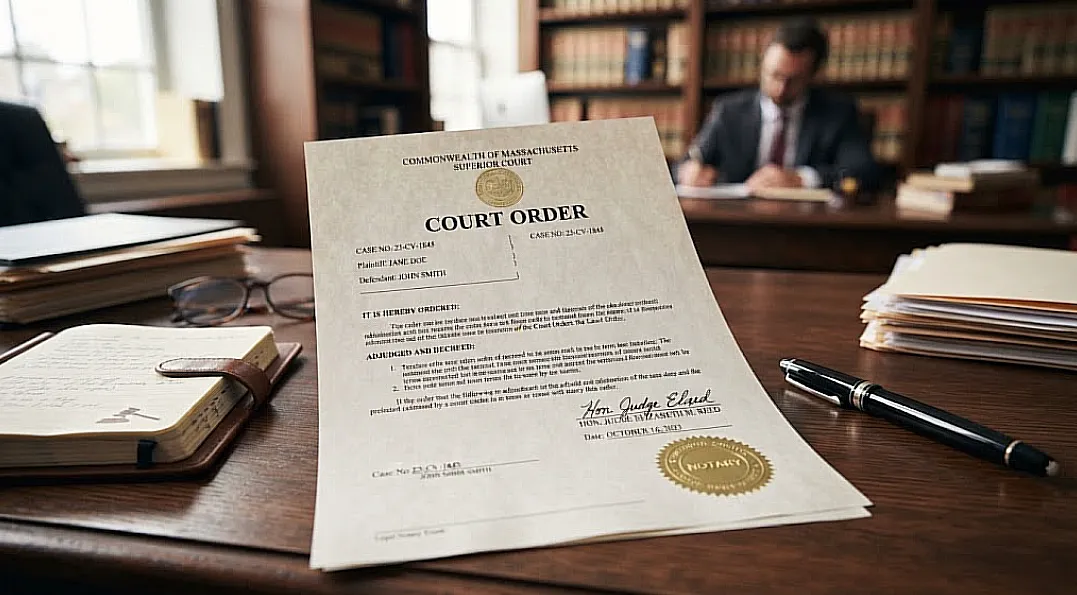
An injunction is a court order requiring someone to take a particular action or stop taking a particular action.
Unlike a typical damages award, which compensates someone for a past injury, an injunction is often concerned with preventing continuing or future harm.
For example, a court might order a party to:
The exact relief depends on the facts and the legal authority allowing the court to issue the order.
Injunctions are not automatically available simply because someone has been wronged. Courts generally consider whether monetary damages or another legal remedy would be adequate and whether the requirements for equitable relief have been satisfied.
The basic purpose of an injunction is to prevent a legal injury from continuing or occurring when waiting for ordinary relief could be inadequate.
Suppose a person discovers that a former business partner is about to disclose confidential information. A lawsuit seeking money after the disclosure may not fully restore the competitive advantage that was lost.
Or imagine that a property owner faces an immediate threat that someone will destroy or substantially alter disputed property. A later damages award may not restore the property to its previous condition.
In these circumstances, the central question is not simply, "How much money would compensate the plaintiff?"
The question may instead be:
Would waiting for the ordinary litigation process cause harm that cannot adequately be fixed later?
That concept is closely connected to irreparable harm.
Irreparable harm generally refers to an injury that cannot be adequately compensated through a later monetary award. Courts frequently consider irreparable harm when deciding whether to issue temporary restraining orders and preliminary injunctions.
"Irreparable harm" does not necessarily mean that the person will suffer the worst possible injury.
It generally means the injury cannot be adequately remedied through ordinary legal damages.
The precise analysis depends on the facts and the jurisdiction.
Examples can potentially include situations involving:
Courts examine the actual circumstances rather than applying a universal list.
Importantly, simply saying that something is serious or upsetting does not automatically establish irreparable harm. The party requesting an injunction generally must provide evidence supporting the claimed harm and explain why ordinary legal remedies would not be sufficient.
The three commonly discussed forms are:
Although all three involve court-ordered restrictions or requirements, they serve different purposes and operate at different stages of a case.
A temporary restraining order, or TRO, is a short-term court order intended to address an urgent situation while the court considers more lasting relief.
A TRO may be requested when someone faces immediate harm and there may not be enough time to conduct a full hearing before the harm occurs.
Under Federal Rule of Civil Procedure 65, a federal court can issue a TRO without notice to the opposing party in limited circumstances. The requesting party must provide specific facts showing that immediate and irreparable injury is likely to occur before the opposing party can be heard, and the attorney must certify the efforts made to provide notice and why notice should not be required.
That makes an emergency, without-notice TRO an extraordinary form of relief rather than an automatic first step in every civil case.
Federal Rule 65 generally limits an initial TRO issued without notice to no more than 14 days, subject to the rule's provisions concerning extension and other circumstances.
The purpose is temporary.
The court typically uses the period to move toward a hearing concerning a preliminary injunction or other appropriate relief.
State law may establish different procedures and terminology.
A preliminary injunction is an order issued before the final resolution of a lawsuit that is intended to preserve the situation while the case proceeds.
Unlike an emergency TRO issued without notice, a preliminary injunction generally requires notice to the opposing party and an opportunity for the parties to be heard.
A preliminary injunction can last substantially longer than a TRO.
Its purpose is often to prevent the plaintiff from suffering serious harm during the time it takes to resolve the underlying dispute.
For example, if a plaintiff claims that a defendant is about to take an action that would cause irreversible harm, the plaintiff may ask the court to temporarily prohibit that action while the lawsuit proceeds.
A permanent injunction is generally issued as part of a final judgment.
The word "permanent" does not necessarily mean that the order can never be changed under any circumstances. Rather, it generally distinguishes the order from temporary or preliminary relief issued while a case is pending.
A permanent injunction can require a person or organization to stop particular conduct or take a particular action.
Courts generally consider whether monetary damages are inadequate and whether equitable relief is appropriate under the circumstances. The Supreme Court's decision in eBay Inc. v. MercExchange is an important federal case concerning the standards for permanent injunctions.
The two remedies can look similar because both can restrict conduct before the final resolution of a case.
The major difference is their purpose and procedure.
A TRO is designed for immediate, short-term protection. In federal court, a TRO may be issued without notice in narrowly defined circumstances involving immediate and irreparable harm.
A preliminary injunction is generally considered after notice and a hearing. It can remain in effect while the litigation continues, depending on the court's order and circumstances.
A simple way to think about them is:
TRO: "We need immediate, temporary protection."
Preliminary injunction: "We need protection while the lawsuit is being decided."
Permanent injunction: "The court has resolved the case and is ordering this conduct going forward."
The actual legal standards and procedures can vary, particularly in state court.
In federal court, the Supreme Court's framework generally requires consideration of four factors:
This framework comes from Winter v. Natural Resources Defense Council, Inc. and is reflected in federal preliminary-injunction doctrine.
These factors are not simply four boxes that a plaintiff can check by making unsupported statements.
The court examines the evidence and legal arguments presented by the parties.
The plaintiff generally must show a sufficiently strong legal and factual basis for the underlying claim.
A person cannot ordinarily obtain an injunction simply by asserting that the defendant did something wrong.
The court may examine the applicable law, evidence, contracts, documents, testimony, and other materials presented at the preliminary stage.
The plaintiff must generally show that the threatened injury cannot adequately be remedied by money or another ordinary legal remedy.
This requirement helps distinguish cases needing immediate equitable intervention from ordinary disputes where a damages award may provide adequate relief.
The court may consider the harm that the injunction would cause the defendant compared with the harm the plaintiff would suffer without it.
An injunction can impose significant restrictions on another party, so courts generally consider the practical consequences on both sides.
Courts can also consider how the requested injunction would affect people beyond the immediate parties.
The public-interest factor can become particularly important in cases involving public institutions, environmental issues, government actions, constitutional rights, or matters affecting large groups of people.
In limited circumstances, yes.
Federal Rule 65 allows a federal court to issue a TRO without notice when specific facts establish that immediate and irreparable injury will occur before the opposing party can be heard and the requesting attorney satisfies the rule's certification requirements.
This is commonly called ex parte relief.
Because the opposing party does not have the opportunity to present its position before the initial order, courts treat this type of relief differently from ordinary injunction proceedings.
The order is temporary and is generally followed by further proceedings.
State courts have their own rules concerning emergency restraining orders.
Not every injunction tells someone to stop doing something.
A prohibitory injunction generally prevents a party from taking a particular action.
A mandatory injunction requires a party to take a particular action.
For example, an order might prohibit a person from using disputed property, while a mandatory injunction might require a party to take an affirmative step to address a particular legal violation.
Mandatory injunctions can have significant practical effects because they require conduct rather than merely prohibiting it.
The availability and standards for such relief depend on the governing law and facts.
Injunctions can arise in many different types of civil disputes.
An injunction may be requested when someone claims that another party is interfering with property rights or threatening to alter or destroy disputed property.
The requested order might prohibit construction, removal, destruction, transfer, or another action.
Whether an injunction is appropriate depends on the applicable property law and equitable requirements.
Some contract disputes involve conduct that cannot easily be remedied through damages.
A party may seek an injunction where the contract or applicable law provides a basis for preventing particular conduct or requiring compliance.
However, not every breach of contract justifies an injunction. Courts generally consider whether monetary damages or another remedy would be adequate.
Businesses may seek injunctions involving:
The legal standards depend on the underlying claim.
Injunctions can play an important role in intellectual-property disputes.
A plaintiff may seek an order preventing continued infringement or misuse of intellectual property.
Federal law and specialized doctrines can apply depending on whether the dispute involves trademarks, copyrights, patents, or trade secrets.
An injunction may be sought where continuing conduct allegedly creates environmental harm, property damage, or a nuisance that cannot adequately be remedied through money alone.
These cases can involve complex factual and regulatory questions.
State courts may provide restraining-order procedures for certain forms of harassment, stalking, domestic violence, or other conduct.
These procedures are not necessarily identical to the federal civil injunction process.
A person facing an immediate safety threat should use the emergency and law-enforcement resources available in the applicable jurisdiction rather than assuming that an ordinary civil lawsuit is the fastest solution.

No.
This is an important distinction.
A preliminary injunction is generally issued before the court has reached a final decision on the underlying claims.
The court may determine that temporary relief is necessary to prevent irreparable harm while the case continues.
That does not necessarily mean the plaintiff will ultimately prevail at trial.
Likewise, denying a preliminary injunction does not necessarily mean the defendant will win the lawsuit.
The underlying case can continue even after a request for preliminary relief is granted or denied.
The evidence depends on the case.
A party seeking an injunction may rely on:
The evidence should support both the underlying legal claim and the need for immediate equitable relief.
For example, simply stating that a defendant "might cause harm" may be less persuasive than presenting specific evidence showing what the defendant is doing, when the threatened action is likely to occur, and why the resulting injury could not adequately be repaired later.
A court may require security when issuing a preliminary injunction or TRO.
Federal Rule 65 provides that a court generally must require the applicant to provide security in an amount the court considers proper for costs and damages that may be incurred by a party who is later found to have been wrongfully restrained or enjoined, subject to exceptions in the rule.
The purpose is to protect the party who is restricted by the injunction if the court later determines that the relief should not have been issued.
The amount and requirements can depend on the case.
State courts may follow different rules.
An injunction is not supposed to be a vague instruction to "behave appropriately."
Federal Rule 65 requires an injunction or restraining order to state the reasons for issuance, specify its terms, and describe the prohibited or required conduct in reasonable detail.
This specificity matters because the person subject to the order needs to understand what conduct is prohibited or required.
An injunction might say that a defendant cannot contact a particular person, cannot transfer specific property, cannot use identified confidential information, or must take a particular action.
The exact language of the order controls.
Generally, an injunction binds the parties to the case and other persons covered by the applicable procedural rules.
Federal Rule 65 provides that an injunction or restraining order binds the parties, their officers, agents, servants, employees, attorneys, and certain people acting in concert or participation with them who receive actual notice of the order.
This means a person should not assume that an injunction can simply be ignored because they were not the named defendant.
Whether a particular person or entity is bound depends on the language of the order and applicable law.
Violating a court order can lead to serious consequences.
A person who knowingly violates an injunction may potentially be held in contempt of court. Depending on the circumstances, contempt can be civil or criminal and can result in sanctions.
Possible consequences can include:
The consequences depend on the type of injunction, the nature of the violation, the court's authority, and the applicable contempt rules.
If someone believes an injunction is wrong, the safer legal approach is generally to seek modification, dissolution, clarification, or appellate review where available rather than simply violating the order.
Sometimes.
Circumstances can change during litigation.
For example, new evidence may emerge, the underlying dispute may be resolved, or the reasons supporting emergency relief may no longer exist.
A party may ask the court to:
The procedure depends on the court and the type of injunction involved.
A person should not unilaterally decide that an injunction has expired or no longer applies unless the applicable order and law clearly establish that result.
Depending on the type of injunction and the applicable procedural rules, an injunction decision may be subject to appellate review.
Federal preliminary-injunction decisions can generally be appealed under applicable federal appellate procedure.
The rules governing appeals of TROs and other interlocutory orders can be more complicated.
The existence of an appeal does not necessarily mean the injunction automatically stops applying.
A party may need to request a stay or other relief from the appropriate court.
This is another situation where ignoring an order while waiting for an appeal can create unnecessary legal risk.
Yes.
A defendant can challenge the request for injunctive relief and present evidence and legal arguments explaining why the injunction should not be issued.
The defense may argue, depending on the case, that:
A defendant can also challenge the scope of an existing injunction or seek to modify or dissolve it when legally appropriate.
The biggest difference is the type of remedy.
Damages generally provide monetary compensation for legally recognized losses.
An injunction orders a person to do something or refrain from doing something.
For example, imagine a company improperly uses another company's confidential information.
A damages award could compensate the injured business for losses that have already occurred.
An injunction could potentially prevent continued misuse of the information.
A case can involve both forms of relief when the applicable law permits them.
Courts may therefore award damages for past harm while also issuing an injunction addressing continuing conduct.
In some circumstances, emergency injunctive relief can be sought at the beginning of litigation, including through a TRO request.
The precise procedure depends on the jurisdiction.
In federal court, Rule 65 governs TROs and preliminary injunctions. A party seeking a TRO generally files a motion supported by the facts and legal basis for the requested relief. A request for an emergency order without notice must satisfy the specific requirements of Rule 65.
State courts may use different forms and procedures.
Someone facing an imminent legal problem should therefore determine which court has jurisdiction and what emergency procedure that court requires.
A nationwide injunction is an injunction that purports to prevent enforcement of a law or government action beyond the parties directly involved in the lawsuit.
This is a specialized and controversial area of federal equitable relief and is not representative of the ordinary injunctions involved in private civil disputes.
In 2025, the U.S. Supreme Court addressed the scope of universal injunctions in Trump v. CASA, Inc. and held that such relief is likely not authorized under the Judiciary Act of 1789 absent congressional authorization.
For ordinary civil disputes, the more practical question is generally the scope of the specific order and which people or entities it legally binds.
A court can deny injunctive relief even when a plaintiff has a legitimate underlying dispute.
Potential reasons include:
If the plaintiff can be fully compensated through a monetary award, extraordinary equitable relief may not be appropriate.
If the alleged injury is speculative, remote, or adequately compensable through ordinary legal remedies, the requirements for preliminary relief may not be satisfied.
A plaintiff generally needs a legally and factually sufficient basis for the underlying claim.
The requested order may impose greater harm on the defendant than the plaintiff would suffer without it.
In some cases, the requested injunction could adversely affect interests beyond the parties.
Courts generally require injunctions to be specific. A request that goes far beyond the alleged legal injury may be narrowed or denied.
Filing a lawsuit does not automatically entitle someone to an injunction.
The requesting party must satisfy the applicable legal requirements.
An injunction is often sought because timing matters. Waiting until the threatened harm is imminent can make the practical situation more difficult.
A request for emergency relief usually needs specific factual support.
Documents, sworn statements, photographs, records, and other evidence can matter.
Courts generally require specific and reasonably detailed injunctions.
A request that attempts to control conduct unrelated to the actual legal dispute may create problems.
Federal Rule 65 does not automatically govern every state-court injunction.
State courts have their own rules and procedures.
If a person believes an injunction is wrong, the appropriate response is generally to challenge it through the court rather than disregard it.
Violating a court order can lead to contempt proceedings and other consequences.
An injunction can affect someone's rights and obligations immediately, so legal advice can be particularly important when emergency relief is involved.
A lawyer may help determine:
Because the standards and procedures vary between federal and state courts, the specific jurisdiction matters.
Take the order seriously.
Read the actual court order rather than relying on someone else's description of it.
Identify:
Keep a copy of the complete order and related court documents.
If you believe the order is incorrect, overly broad, or impossible to comply with, contact a lawyer promptly and seek appropriate relief from the court.
Do not assume that an objection, appeal, or disagreement automatically suspends the order.

An injunction is a powerful civil-law remedy that allows a court to order someone to stop doing something or take a specific action. Unlike ordinary damages, which generally compensate for legally recognized losses, an injunction is often designed to prevent or address harm that cannot adequately be remedied with money.
The three major forms are temporary restraining orders, preliminary injunctions, and permanent injunctions. A TRO is generally a short-term emergency measure, while a preliminary injunction can provide protection during an ongoing lawsuit. A permanent injunction is typically issued as part of a final judgment.
In federal court, preliminary-injunction decisions generally involve consideration of likelihood of success, irreparable harm, the balance of equities, and the public interest. Federal Rule of Civil Procedure 65 also establishes specific procedures for TROs, preliminary injunctions, security, and the form and scope of injunction orders.
Injunctions can arise in many areas of civil law, including property disputes, contracts, business conflicts, intellectual-property cases, environmental matters, and other disputes involving continuing or threatened harm.
However, an injunction is not automatically available simply because a person has suffered a legal wrong. Courts generally require the requesting party to satisfy specific legal standards and provide sufficient evidence to justify equitable relief.
The rules also vary significantly between federal and state courts. Someone considering an injunction should therefore identify the applicable jurisdiction, understand the relevant procedural requirements, gather evidence supporting the alleged harm, and determine whether ordinary monetary damages would be inadequate.
Because an injunction can impose immediate legal obligations, anyone seeking or defending against one should consider obtaining advice from a qualified attorney familiar with the applicable court and area of law.
This article provides general legal information and is not a substitute for legal advice about a particular dispute.

Written by
BeastBeast is a seasoned legal content creator and law research specialist with 15+ years of experience in legal writing, legal research, and publishing educational law content. Specializing in Personal Injury, Family, Business, Immigration, Criminal, Tax, and Real Estate Law, Beast creates accurate, well-researched, and SEO-optimized legal guides that help readers understand complex legal topics with confidence. Every article is written with a focus on accuracy, trust, and Google's E-E-A-T guidelines, making Jurnza.com a reliable source for legal information and legal services.
