Deadlines & Filing
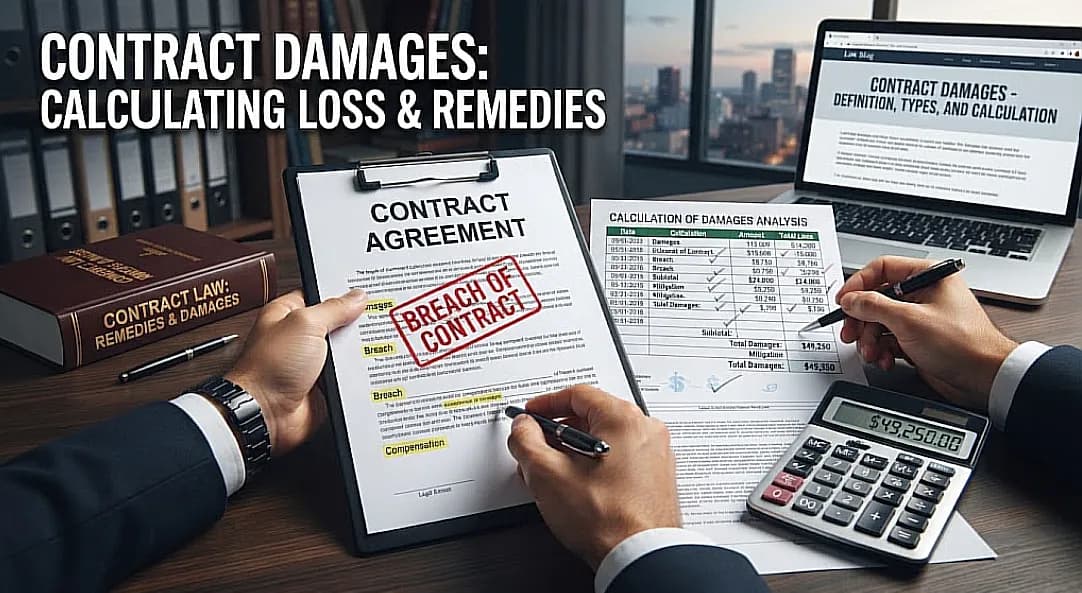
Contract damages are remedies available when a party fails to perform a legally enforceable agreement. Learn how expectation, reliance, restitution, consequential, incidental, and liquidated damages work, how lost profits and replacement costs may be calculated, and when specific performance may be available. This guide also explains mitigation, contractual limits on damages, deposits, evidence needed to prove losses, UCC remedies for sales contracts, and common mistakes to avoid after a breach.
When one party fails to perform its obligations under a valid contract, the other party may suffer financial losses, lose the benefit of a bargain, or incur additional expenses trying to deal with the breach. Contract law provides several potential remedies for these situations, but the amount a person can recover is not necessarily equal to whatever loss they claim to have experienced. Contract damages are generally intended to compensate the non-breaching party rather than punish the party that breached the agreement. The central objective is usually to place the injured party in approximately the economic position they would have occupied if the contract had been performed as promised. Depending on the circumstances, that may involve compensation for the expected benefit of the agreement, expenses incurred in reliance on the contract, benefits transferred to the other party, additional costs caused by the breach, or other legally recoverable losses.
The type and amount of damages available can depend on the nature of the contract, the wording of the agreement, the type of breach, the losses involved, applicable state law, and whether a statute such as the Uniform Commercial Code (UCC) applies. Contracts for the sale of goods, for example, are generally governed by UCC Article 2, while many other contracts are governed primarily by state common law and statutes.
Understanding the different categories of contract damages can help explain what a person may be able to seek after a breach and why proving damages is often one of the most difficult parts of a contract dispute.
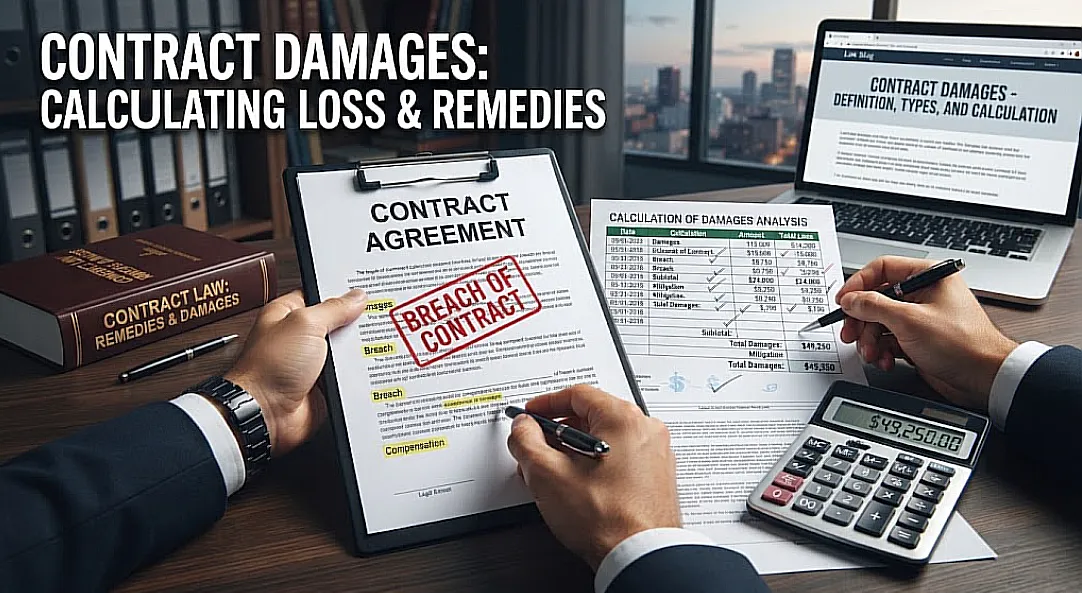
Contract damages are monetary compensation or other remedies awarded because a party failed to fulfill a legally enforceable contractual obligation. In a typical breach-of-contract dispute, the injured party seeks compensation for losses caused by the breach.
For example, suppose a business agrees to purchase equipment from a supplier for $50,000. The supplier breaches the agreement and refuses to deliver the equipment. If the buyer has to purchase comparable equipment elsewhere for $60,000, the buyer may have a claim for the additional cost, subject to the applicable rules and the specific circumstances.
The basic idea is not that the breaching party should automatically be punished. Instead, contract remedies generally seek to compensate the injured party for the legally recognized consequences of the breach.
This distinguishes contract damages from punitive damages in many tort cases. Punitive damages are generally not available simply because someone breached a contract. Contract law is primarily compensatory, although separate claims involving fraud, bad faith, or another independent legal wrong may sometimes involve different remedies.
The contract itself can also affect the available remedies. Parties may agree to certain limitations, exclusive remedies, or liquidated-damages provisions, although such provisions are subject to applicable law and may not always be enforceable.
A person generally cannot recover contract damages simply because they believe another party acted unfairly or failed to keep a promise.
The claimant ordinarily needs to establish that an enforceable contract existed, the other party failed to perform an obligation required by the agreement, and the breach caused legally recoverable harm.
Contract formation requirements vary somewhat by jurisdiction and by the type of agreement, but common principles include mutual assent, consideration, contractual capacity, and a lawful purpose.
The exact elements of a breach-of-contract claim can differ under state law. Some disputes also involve questions about whether a party substantially performed, whether the other side materially breached first, whether performance was excused, or whether a contractual condition was satisfied.
Even after establishing a breach, the injured party generally must prove the amount and type of damages claimed.
That can become complicated when the alleged losses involve future profits, business opportunities, indirect losses, or expenses that could have been avoided.
Expectation damages are one of the most important concepts in contract law.
The purpose of expectation damages is generally to place the non-breaching party in the economic position they would have occupied if the contract had been fully performed. They are sometimes described as giving the injured party the "benefit of the bargain."
Consider a simple example.
A contractor agrees to install a commercial HVAC system for $100,000. The customer pays according to the agreement, but the contractor fails to complete the work. If the customer reasonably has to spend $125,000 to obtain equivalent performance from another contractor, the additional $25,000 may potentially form part of an expectation-damages claim, depending on the contract and applicable law.
The calculation is not always that simple.
Courts may consider the value of the promised performance, the value actually received, additional expenses, amounts saved because of the breach, and other legally relevant factors.
Expectation damages are particularly important because they focus on what the injured party was supposed to receive under the contract rather than simply looking at what the party spent.
Reliance damages focus on expenses or losses incurred because a person relied on the contract or promise.
Instead of asking, "What would the injured party have received if the contract had been performed?" reliance damages ask, in general terms, "What did the injured party lose because they reasonably relied on the agreement?"
For example, imagine a company signs an agreement for a major event and spends $20,000 preparing for the project. The other party later breaches the agreement, and the preparation expenses become useless.
Depending on the circumstances and applicable law, some of those expenses may potentially be recoverable as reliance damages.
Reliance damages can also arise in certain situations involving promissory estoppel, where a formal enforceable contract may not exist but one party reasonably and detrimentally relied on another's promise.
However, reliance damages are not an automatic reimbursement of every expense someone incurred.
The expenses generally must have a sufficient legal connection to the agreement or promise, and courts may reject costs that are speculative, unreasonable, unnecessary, or incurred after the party knew performance would not occur.
Restitution serves a different purpose from expectation damages.
Instead of focusing primarily on the benefit the injured party expected from the contract, restitution can seek to prevent one party from unfairly retaining a benefit received from another.
For example, suppose a customer pays $30,000 to a contractor before construction begins, but the contract is later rescinded or the contractor is legally required to return the payment. Restitution may involve returning money or another benefit that one party received.
Restitution is particularly relevant when a party has transferred money, property, services, or another benefit and retaining that benefit would produce an unjust result under the applicable law.
Cornell's Legal Information Institute identifies restitution as an equitable remedy that can require the party who received a benefit to return it in appropriate circumstances.
The availability and calculation of restitution depend heavily on the facts and the legal theory being used.
Consequential damages, sometimes called special damages, can involve losses that occur as a consequence of the breach rather than the immediate value of the promised performance.
These damages can be more difficult to prove because the claimant must generally establish a sufficient connection between the breach and the additional loss.
For example, imagine a manufacturer contracts to receive a critical machine from a supplier. The supplier fails to deliver it, and the manufacturer claims that production losses followed.
The manufacturer may attempt to claim losses beyond the direct cost of the machine, but whether those losses are recoverable can depend on issues such as foreseeability, causation, proof, mitigation, and the terms of the contract.
For contracts governed by UCC Article 2, the rules expressly address consequential damages. A buyer may potentially recover losses resulting from particular requirements or needs that the seller had reason to know about when the contract was made and that could not reasonably have been prevented through cover or otherwise.
For non-UCC contracts, the applicable state-law rules can differ.
A party who breaches a contract is not necessarily responsible for every consequence that happens afterward.
Foreseeability can limit the damages that may be recovered.
Suppose a supplier agrees to deliver ordinary office furniture but fails to do so. The buyer later claims millions of dollars in losses from an unrelated business opportunity that allegedly fell through because the furniture was not delivered.
The buyer would generally face substantial difficulties establishing that such a remote loss should be attributed to the supplier's breach.
By contrast, if the supplier knew when the contract was made that a particular failure would likely cause a specific type of loss, the claimant may have a stronger argument, depending on the governing law.
The exact test varies by jurisdiction and contract type, so consequential damages should always be evaluated under the applicable law rather than assumed to be recoverable.
Incidental damages are generally associated with reasonable expenses resulting from dealing with the breach.
For example, a buyer whose supplier fails to deliver goods may incur reasonable expenses searching for replacement goods, arranging substitute delivery, inspecting rejected goods, or handling other consequences of the seller's failure.
The UCC expressly recognizes various categories of incidental expenses in sales transactions.
These damages are different from consequential damages.
Incidental damages generally involve the reasonable costs associated with responding to the breach, while consequential damages can involve additional losses flowing from the breach and particular circumstances.
The distinction can matter when determining what evidence is necessary to support a claim.
Lost profits are among the most frequently disputed forms of contract damages in business litigation.
A company may argue that another party's breach caused it to lose sales, customers, production, or anticipated revenue.
But revenue and profit are not the same thing.
If a business claims that it lost $500,000 in sales, that does not necessarily mean it suffered $500,000 in lost profits. The business may have avoided expenses that would have been necessary to generate those sales.
The claimant may therefore need evidence showing how the alleged profits would have been generated and what costs would have been incurred.
Courts can also scrutinize whether the claimed profits are sufficiently certain rather than speculative.
For an established business with reliable historical records, detailed financial information, existing contracts, and a demonstrable pattern of sales, proving lost profits may be more straightforward than for a new business attempting to predict profits it has never previously earned.
The specific standards differ by jurisdiction and type of claim.
Some contracts determine damages in advance.
A liquidated-damages provision specifies an amount or formula that will apply if a particular breach occurs.
For example, a construction contract might provide that a contractor owes a specified amount for each day of unjustified delay.
Liquidated damages can be useful when actual losses would be difficult or expensive to calculate after a breach.
However, parties generally cannot simply disguise a punishment as liquidated damages and assume that a court will enforce it.
The enforceability of a liquidated-damages clause depends on applicable law and the wording and circumstances surrounding the provision.
Under UCC § 2-718, for example, a liquidated-damages provision in a sales contract must be reasonable in light of anticipated or actual harm, the difficulty of proving the loss, and the difficulty of obtaining an adequate remedy. An unreasonably large amount can be treated as an unenforceable penalty.
Other contracts may be governed by different state-law tests.
That is why a clause labeled "liquidated damages" is not automatically enforceable.
Yes, contracts sometimes contain provisions limiting the damages a party can recover.
A contract might attempt to:
Whether such provisions are enforceable depends on the contract, the type of transaction, applicable statutes, public policy, and state law.
For sales of goods, UCC § 2-719 permits agreements that modify or limit remedies in certain circumstances. It also addresses limitations or exclusions of consequential damages and recognizes circumstances in which an exclusive or limited remedy may fail of its essential purpose.
Similar principles may apply differently outside the UCC.
A person evaluating a breach claim should therefore read the entire contract rather than looking only at the provision describing the parties' primary obligations.
A limitation-of-liability clause buried near the end of an agreement may substantially affect the potential value of a claim.
Money is the most common remedy for breach of contract, but it is not the only possible remedy.
In some circumstances, a court may order specific performance. This means the breaching party is required to perform the contractual obligation rather than simply paying money.
Specific performance is generally associated with situations where monetary compensation would not adequately address the harm.
Real estate is a classic example because a particular piece of land may be considered unique. A buyer who has contracted to purchase a specific property may argue that money cannot fully replace the property itself.
Courts may also consider specific performance in certain disputes involving unique goods or other circumstances where substitute performance is unavailable or inadequate.
The remedy is generally more exceptional than an award of monetary damages. Courts typically consider whether damages provide an adequate remedy and whether equitable relief is appropriate under the circumstances.
Contracts for the sale of goods have specific remedies under the UCC.
When a seller breaches by failing to deliver goods, a buyer may sometimes purchase substitute goods, a process commonly known as "cover."
Under UCC § 2-712, a buyer can make a good-faith and commercially reasonable substitute purchase without unreasonable delay. The buyer may then recover the difference between the cost of cover and the original contract price, along with qualifying incidental or consequential damages, less expenses saved because of the breach.
For example, suppose a business agrees to purchase inventory for $40,000. The seller breaches, and the buyer reasonably purchases comparable inventory for $46,000.
The $6,000 difference may potentially be part of the buyer's damages under the UCC, assuming the applicable requirements are satisfied.
The buyer should nevertheless preserve evidence showing what happened, why the replacement purchase was reasonable, and how the amount was calculated.
A buyer does not always have to cover after a seller's breach.
Under UCC § 2-713, a buyer may potentially recover the difference between the market price at the legally relevant time and place and the contract price, along with qualifying incidental and consequential damages, less expenses saved because of the breach.
The exact calculation depends on the transaction and statutory requirements.
This illustrates why contract damages can vary significantly depending on the type of agreement involved.
A breach involving a commercial sale of goods may be governed by detailed statutory formulas, while a dispute involving professional services, construction, employment, or another type of agreement may rely primarily on state common-law principles and contractual provisions.
One of the most important limitations on contract damages is mitigation.
A person who suffers a breach generally cannot simply allow losses to continue increasing and then demand that the breaching party pay for all of them.
The mitigation principle generally requires reasonable efforts to avoid or reduce losses caused by the breach. Cornell's Legal Information Institute describes the doctrine as preventing recovery for losses that could have been avoided through reasonable efforts.
Consider a simple example.
A tenant breaches a lease and leaves a property unexpectedly. Depending on the applicable law, the landlord may have a duty to make reasonable efforts to find a replacement tenant rather than leaving the property vacant indefinitely and attempting to charge the former tenant for every month remaining on the lease.
Similarly, a buyer whose supplier breaches may need to consider reasonable substitute purchases rather than intentionally allowing business losses to accumulate.
Mitigation does not necessarily require a person to take unreasonable or extraordinary measures. The question is generally what reasonable steps were available under the circumstances.

Attorney's fees are not automatically included in every contract-damages award.
In the United States, the availability of attorney's fees can depend on the contract, a statute, procedural rules, or another applicable legal basis.
Some contracts contain attorney-fee provisions requiring the losing party or breaching party to pay certain legal expenses. Other statutes independently authorize attorney's fees for particular types of claims.
The rules can also differ depending on whether the contract involves consumers, employees, businesses, government entities, or regulated industries.
Therefore, someone should not automatically add attorney's fees to the amount of damages they believe they are owed without examining the governing law and the agreement itself.
Punitive damages are generally not awarded merely because a party breached a contract.
The primary function of ordinary contract damages is compensation rather than punishment.
However, a dispute may involve conduct that gives rise to an independent legal claim.
For example, allegations of fraud, certain forms of bad faith, or another tort may potentially create remedies beyond those available for the contract claim itself.
Whether such a claim exists depends on the facts and applicable law.
A party should therefore distinguish between:
A breach of contract: A party fails to perform a contractual obligation.
An independent legal wrong: The same conduct may also violate another legal duty recognized by statute or common law.
The availability of additional damages cannot be assumed simply because the breach was intentional or particularly harmful.
There is no single formula that applies to every contract dispute.
The calculation may involve several components.
For example, an injured party might claim:
Value of promised performance
minus
Value actually received
plus
Qualifying incidental or consequential losses
minus
Expenses saved or losses avoided
subject to
Contractual limitations and applicable legal rules.
That is only a general framework.
The actual calculation can depend on the type of contract and the remedy being pursued.
A sales contract may use UCC formulas. A construction dispute may involve the cost of completing or correcting defective work. A service agreement may involve the cost of obtaining substitute services. A business dispute may involve lost profits or other financial consequences.
Expert testimony may sometimes be necessary when damages involve complicated financial calculations, business valuations, accounting issues, or projected profits.
A strong damages claim usually requires evidence.
Potentially relevant records may include:
The exact evidence depends on the type of damages claimed.
For example, a person claiming $15,000 in replacement costs should be able to explain where the number came from. A business claiming $500,000 in lost profits may need considerably more detailed financial evidence.
Documentation can also help establish the timing of the breach and demonstrate that the claimant took reasonable steps to limit the resulting losses.
One of the biggest challenges in contract litigation is distinguishing a genuine financial loss from a prediction or estimate that is too uncertain.
Suppose a newly created business claims that a breached contract caused $10 million in future profits.
The business may need to prove more than the fact that the contract could have been profitable. It may need evidence showing why those profits were reasonably predictable, how the business would have generated them, what expenses would have been incurred, and why the claimed amount is not merely speculative.
Reliance damages can face similar problems when a claimant seeks reimbursement for expenses that cannot be connected reliably to the agreement.
Courts may examine whether the alleged losses can be established with sufficient evidence rather than relying on assumptions.
This does not mean that future damages are always unavailable. It means that the claimant generally needs a legally sufficient basis for calculating them.
Contract disputes are not always one-sided.
Sometimes each party alleges that the other breached first.
For example, a construction company may claim that a property owner failed to make required payments, while the owner argues that the contractor failed to complete the work properly.
When both sides accuse each other of breach, the court may need to determine:
The result may affect whether one party can recover damages, whether damages are reduced, or whether competing claims result in an offset or other outcome.
The applicable rules vary considerably by jurisdiction and type of contract.
Not every deviation from a contract necessarily produces the same legal consequences.
A minor failure may be treated differently from a substantial failure that defeats the essential purpose of the agreement.
For example, if a contractor completes almost all agreed work but makes a relatively minor defect that can easily be corrected, the legal consequences may differ from a situation in which the contractor abandons the project halfway through.
The contract itself may define deadlines, conditions, notice requirements, cure periods, or consequences for particular breaches.
Courts may also apply state-law principles concerning substantial performance, material breach, anticipatory repudiation, and conditions of performance.
Because these doctrines can significantly affect damages, identifying the exact nature of the breach is often as important as calculating the financial loss.
A party may sometimes breach a contract before the actual performance date.
This can happen when one party clearly communicates that it will not perform its contractual obligations when performance becomes due.
Such conduct can create an anticipatory-breach or repudiation issue, depending on the governing law.
The injured party may have options that differ from simply waiting until the performance date passes.
In sales-of-goods transactions, for example, the UCC contains specific rules addressing repudiation and the buyer's remedies, including cover and market damages.
The appropriate response depends on the contract and applicable law, and acting quickly can sometimes affect the amount of recoverable damages.
A liquidated-damages clause can significantly change the damages analysis.
Instead of requiring the injured party to prove every dollar of actual loss, the contract may establish an agreed amount or formula for a particular breach.
But the provision still needs to comply with applicable law.
For example, the UCC's sales provisions permit liquidated damages when the agreed amount is reasonable in light of anticipated or actual harm and related factors. An unreasonably large amount may be treated as a penalty rather than enforceable liquidated damages.
State common law may apply a different test to other contracts.
When reviewing a liquidated-damages clause, it is therefore important to consider not only the amount but also why the amount was selected, what type of breach triggers it, and whether the provision conflicts with another remedy in the agreement.
A contract may attempt to exclude consequential damages.
This can be particularly important in commercial agreements because consequential losses can sometimes be much larger than the direct value of the contract.
For example, a software contract might limit the provider's liability to fees paid under the agreement and exclude lost profits or indirect damages.
Whether that clause is enforceable depends on the governing law and circumstances.
The UCC specifically permits certain limitations or exclusions of consequential damages, while also imposing restrictions in particular circumstances.
Outside the UCC, state law governs.
This is one reason businesses should review limitation-of-liability provisions before signing contracts rather than discovering their effect only after a dispute occurs.
Sometimes, but not simply because a breach occurred.
A party's damages may exceed the amount originally paid under a contract if legally recoverable losses justify a larger award.
For example, qualifying consequential damages, reliance expenses, or other recognized losses may add to the direct damages.
But contract law generally does not provide unlimited compensation.
The claimant may face limitations involving foreseeability, causation, mitigation, speculation, contractual liability caps, exclusive remedies, or other legal restrictions.
In some circumstances, the contract may expressly limit the amount recoverable.
The correct question is therefore not simply, "How much was the contract worth?"
It is:
What legally recoverable loss resulted from the breach, and what limitations apply?
Deposits can create complicated remedies issues.
If one party paid money in advance and the contract was breached, the outcome can depend on the agreement, the reason for the breach, whether the deposit was intended as security or liquidated damages, and applicable law.
For sales contracts governed by the UCC, § 2-718 contains rules concerning liquidated damages and restitution of certain deposits.
Outside the UCC, state law and the contract may provide different rules.
A deposit should therefore not automatically be assumed to be nonrefundable simply because the contract calls it a "deposit," nor should it automatically be assumed that the payer is entitled to receive it back.
The legal character and purpose of the payment matter.
If you believe another party breached a contract, taking organized steps can help preserve potential remedies.
Do not focus only on the provision that appears to have been violated.
Look for:
A single paragraph concerning remedies can substantially change the potential outcome.
Write down what the other party promised to do, what actually happened, when the failure occurred, and why you believe it violates the agreement.
Avoid relying solely on general statements such as "they broke the contract."
Specific facts make it easier to identify the appropriate remedy.
Separate your losses into categories.
For example:
Do not inflate the calculation by including every expense that happened around the same time.
The key question is whether each claimed amount has a legally recognizable connection to the breach.
Keep the contract, communications, invoices, receipts, financial records, photographs, estimates, and other evidence.
Do not delete messages or emails simply because they seem unimportant.
A communication showing that the other party acknowledged a missed deadline, promised to correct a problem, or knew about a particular consequence could later become relevant.
Think about reasonable ways to prevent the losses from becoming larger.
Depending on the situation, this might mean obtaining substitute services, purchasing replacement goods, attempting to resell property, finding another tenant, or taking other commercially reasonable steps.
The specific obligation depends on the circumstances and applicable law.
Contract claims are subject to statutes of limitations and, in some circumstances, other contractual or statutory deadlines.
These deadlines vary by jurisdiction and type of contract.
A contract may also require notice within a particular period or require a dispute to be submitted to arbitration before a lawsuit can be filed.
Waiting too long can therefore create problems even when the underlying claim may otherwise have merit.
Legal advice can be particularly useful when the potential damages are substantial or the contract contains complicated restrictions.
An attorney may help evaluate:
A lawyer may also help calculate damages using financial records or experts when the dispute involves complicated business losses.
Not every breach-of-contract dispute requires litigation. Depending on the circumstances, negotiation, mediation, arbitration, or another dispute-resolution process may resolve the matter.
Several mistakes can make a damages claim harder to prove.
A person may experience a genuine financial loss without having a legal right to recover all of it.
Damages must satisfy the applicable legal requirements.
A limitation-of-liability clause or exclusive-remedy provision can significantly affect recovery.
Allowing losses to grow unnecessarily can reduce the amount potentially recoverable.
Lost-profit claims need evidence. Guesswork and optimistic projections may not be enough.
Additional expenses may become difficult to recover if they were unreasonable or avoidable.
Payments may need to be accounted for when calculating the net amount of damages.
A valid claim can become difficult or impossible to pursue if a statute of limitations or contractual deadline expires.
A breach and fraud are different legal concepts. A broken promise does not automatically establish fraudulent conduct.

Contract damages are designed primarily to compensate a party for legally recognized losses resulting from a breach. The most familiar form is expectation damages, which generally seek to provide the benefit of the bargain and place the injured party in the economic position they would have occupied if the agreement had been performed. Other remedies can include reliance damages, restitution, incidental damages, consequential damages, liquidated damages, and, in limited circumstances, specific performance.
The amount a person can recover depends on much more than the fact that a contract was broken. The claimant may need to establish an enforceable agreement, prove the breach, demonstrate causation, document the resulting loss, and satisfy applicable rules concerning foreseeability, certainty, mitigation, and other limitations.
The contract itself can also be extremely important. Liability caps, exclusions of consequential damages, liquidated-damages clauses, exclusive remedies, notice provisions, arbitration requirements, and other terms may influence what happens after a dispute arises.
Contracts involving the sale of goods can involve additional statutory remedies under the Uniform Commercial Code, including cover damages, market damages, and specific rules concerning incidental and consequential losses.
Because contract law is largely governed by state law outside areas covered by specialized statutes, the rules can differ significantly depending on where the dispute arises and what kind of agreement is involved. A person facing a significant contract dispute should review the agreement carefully, preserve evidence, consider reasonable steps to limit additional losses, and determine whether professional legal advice is appropriate.

Written by
BeastBeast is a seasoned legal content creator and law research specialist with 15+ years of experience in legal writing, legal research, and publishing educational law content. Specializing in Personal Injury, Family, Business, Immigration, Criminal, Tax, and Real Estate Law, Beast creates accurate, well-researched, and SEO-optimized legal guides that help readers understand complex legal topics with confidence. Every article is written with a focus on accuracy, trust, and Google's E-E-A-T guidelines, making Jurnza.com a reliable source for legal information and legal services.
