Deadlines & Filing

Adjustment of status and consular processing are two different pathways for eligible immigrants seeking U.S. permanent residence. Learn how the two processes work, who may use each pathway, and how Form I-485, DS-260, the National Visa Center, visa availability, interviews, medical examinations, travel, employment authorization, inadmissibility, unlawful presence, and adjustment bars can affect an immigration case. This guide also explains priority dates, common mistakes, and when an immigration attorney may be helpful.
For many people seeking a U.S. immigrant visa or green card, one of the biggest procedural questions is whether they should complete the immigration process from inside the United States or through a U.S. embassy or consulate abroad. These two pathways are generally known as adjustment of status and consular processing.
Adjustment of status allows an eligible person who is physically present in the United States to apply for lawful permanent resident status without leaving the country for an immigrant-visa interview. The primary application is generally filed with U.S. Citizenship and Immigration Services (USCIS) using Form I-485. USCIS explains that eligibility depends on the immigrant category and other requirements, and the applicant must be physically present in the United States to file the adjustment application.
Consular processing, by contrast, generally involves applying for an immigrant visa through the U.S. Department of State after an immigrant petition has been approved or another qualifying basis exists. The National Visa Center (NVC) handles much of the pre-interview processing before the case is sent to a U.S. embassy or consulate for an interview.
The two procedures can ultimately lead to lawful permanent residence, but they are not interchangeable in every situation. Eligibility, immigration history, visa availability, location, admissibility, family relationships, employment category, and other circumstances can affect which procedure is available.
Understanding the difference can help an applicant avoid choosing a process that does not fit their circumstances.
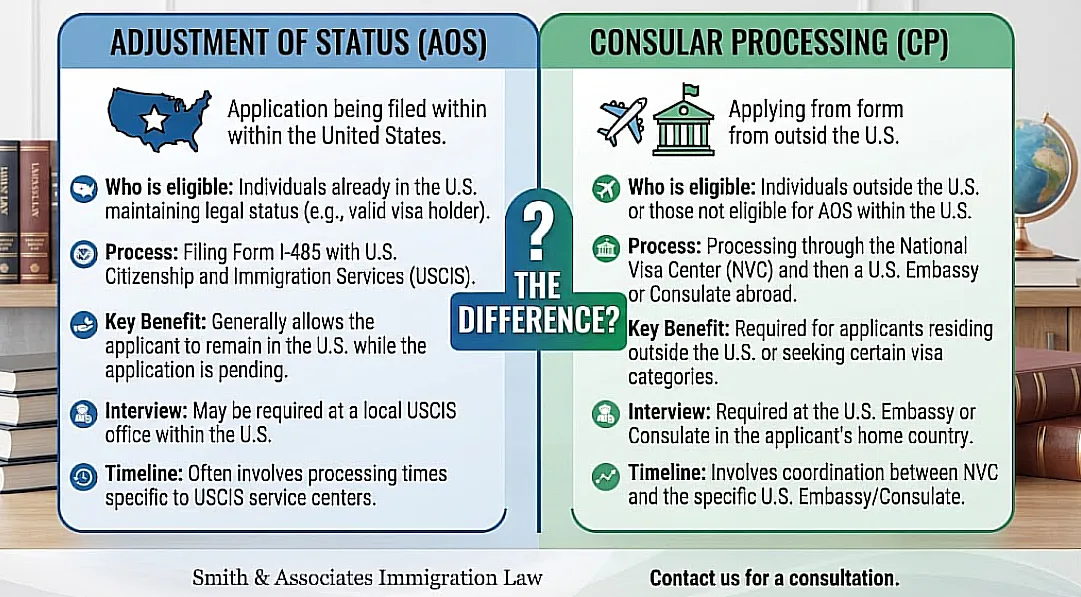
Adjustment of status is the process through which an eligible noncitizen who is already in the United States applies to become a lawful permanent resident without completing immigrant-visa processing at a U.S. consulate abroad.
The principal application is Form I-485, Application to Register Permanent Residence or Adjust Status.
USCIS describes Form I-485 as the application used by a person in the United States to apply for lawful permanent resident status. The agency also explains that adjustment eligibility varies according to the immigrant category involved.
Adjustment of status can arise in several immigration categories, including certain family-based and employment-based cases.
For example, a person in the United States who qualifies for an immigrant category and meets the applicable adjustment requirements may potentially file Form I-485 rather than leaving the country for an immigrant-visa interview.
However, simply being physically present in the United States does not automatically make someone eligible for adjustment.
Immigration law contains specific requirements and restrictions, and some applicants may be barred from adjusting status because of their immigration history or other circumstances.
Consular processing is the procedure generally used when an immigrant visa applicant completes the immigrant-visa process through the Department of State outside the United States.
After USCIS approves an immigrant petition that requires Department of State processing, the case may be transferred to the National Visa Center.
The NVC creates the visa case, provides processing instructions, collects fees and documents, and reviews the case before an interview can be scheduled.
The applicant generally completes the DS-260, Immigrant Visa and Alien Registration Application, submits required civil and financial documents, completes a required medical examination with an authorized physician, and attends an immigrant-visa interview at the assigned U.S. embassy or consulate.
The consular officer then determines whether the applicant is eligible for the immigrant visa under U.S. immigration law.
If the immigrant visa is approved and issued, the applicant can generally use the visa to seek admission to the United States as a permanent resident.
The important distinction is therefore simple:
Adjustment of status generally takes place inside the United States through USCIS, while consular processing generally takes place through the Department of State and a U.S. embassy or consulate abroad.
The legal details behind that distinction, however, are considerably more complicated.
Issue | Adjustment of Status | Consular Processing |
|---|---|---|
Where it generally occurs | United States | Outside the United States |
Main government agency | USCIS | Department of State, with USCIS involvement where applicable |
Main application | Form I-485 | Form DS-260 |
Interview | Generally with USCIS | U.S. embassy or consulate |
Physical location | Applicant is generally in the U.S. | Applicant generally processes abroad |
Medical examination | By a USCIS-designated civil surgeon | By an embassy-approved panel physician |
NVC involvement | Generally not the central processing step | Usually involved in immigrant-visa cases after petition approval |
Visa issuance | Adjustment grants permanent resident status | Immigrant visa is issued before travel |
Travel considerations | Leaving while an adjustment case is pending can create complications depending on circumstances | International travel is inherent in the process |
Work authorization | May be available through a separate employment-authorization process when eligible | Immigrant visa processing itself does not mean the applicant may work in the U.S. before lawful admission |
These are general distinctions. Individual cases can involve exceptions, special procedures, or additional requirements.
Eligibility depends heavily on the immigrant category and the applicant's circumstances.
A person generally needs an available immigrant category and must satisfy the requirements applicable to adjustment of status.
Some family-based cases involve immediate relatives of U.S. citizens, while others fall under family-preference categories. Employment-based immigrants may also qualify for adjustment if the statutory and regulatory requirements are satisfied.
USCIS notes that adjustment eligibility varies according to the immigrant category and that principal applicants and, where permitted, derivative family members may each have their own Form I-485 requirements.
There can also be important differences between categories concerning unlawful status, unauthorized employment, maintenance of status, and other immigration violations.
For example, certain immediate relatives of U.S. citizens receive exceptions from some adjustment bars that can affect other categories. USCIS materials explain that some applicants are subject to adjustment restrictions for failing to maintain lawful status or engaging in unauthorized employment, while certain statutory exceptions apply to particular categories.
That means a person should not assume that another immigrant applicant's experience automatically applies to their own case.
Consular processing is generally used when the applicant is outside the United States or is otherwise required or expected to obtain an immigrant visa abroad.
It is common in family-based and employment-based immigrant cases where the beneficiary will immigrate from another country.
After USCIS approves the qualifying petition, the case may be sent to NVC. The NVC then collects the necessary fees and documents and prepares the case for interview scheduling.
The Department of State explains that immigrant-visa applicants generally complete the DS-260, submit supporting documents, complete the required medical examination, and attend an interview.
The exact process can vary according to the immigrant category and the applicant's country and circumstances.
One of the most important concepts in both immigration pathways is visa availability.
Not every immigrant category has an unlimited number of visas available.
For certain family-preference and employment-based preference categories, U.S. law limits the number of immigrant visas that may be issued each year. Availability can also be affected by country-specific limits and the applicant's priority date.
The Department of State publishes a monthly Visa Bulletin showing visa availability for affected categories.
A person can therefore have an approved immigrant petition and still have to wait for an immigrant visa number to become available.
This is an important distinction:
An approved petition does not necessarily mean that permanent residence can immediately be granted.
The immigration petition establishes eligibility for an immigrant category. Visa availability determines whether an immigrant visa number is available when required.
For some adjustment cases, the applicant must have an immigrant visa immediately available before filing or receiving final approval, depending on the category and applicable rules.
A priority date is an important reference point in many employment-based and family-preference immigration cases.
The priority date can generally be associated with when the qualifying petition was filed, although the rules vary according to the particular immigrant category.
For preference categories, the Department of State uses priority dates in determining visa availability.
The Visa Bulletin contains monthly information about immigrant visa availability, including categories and countries of chargeability.
The NVC explains that even if USCIS approves an immigrant petition, an immigrant visa number may not immediately be available in a category subject to numerical limits.
This issue can affect both adjustment applicants and consular-processing applicants, although the procedural consequences can differ.
Applicants should therefore monitor the applicable Visa Bulletin rather than assuming that an approved petition automatically means the next step can be completed.
A typical adjustment-of-status case can involve several stages.
Depending on the immigration category, an immigrant petition may need to be filed and approved before or together with the adjustment application.
Some categories permit concurrent filing when an immigrant visa is immediately available.
The precise rules depend on the category.
The applicant files Form I-485 with USCIS and provides supporting evidence showing eligibility.
The application can require extensive documentation, including identity documents, immigration records, civil records, and evidence relating to the underlying immigrant category.
USCIS may require the applicant to provide fingerprints, photographs, and a signature as part of the biometrics process.
Applicants generally must complete the immigration medical examination with an authorized civil surgeon when required.
USCIS may schedule an interview to evaluate the application.
Not every case necessarily proceeds in exactly the same way, and USCIS determines whether an interview is required under the applicable procedures.
USCIS may approve the adjustment application, request additional evidence, issue another notice, or deny the application depending on the circumstances.
If approved, the person becomes a lawful permanent resident under the applicable immigration rules.
Consular processing follows a different sequence.
A qualifying immigrant petition may first be submitted to USCIS.
After USCIS approval, the petition may be transferred to the National Visa Center for immigrant-visa processing.
The applicant and petitioner complete the required steps, which can include payment of visa-processing fees and submission of the DS-260 and financial-support documentation.
Applicants generally submit required civil documents, such as birth certificates, marriage records where applicable, police certificates, and other documentation required for the particular case.
NVC reviews the submitted material and determines whether the case contains the required documentation for interview scheduling.
The applicant completes a medical examination with an authorized panel physician before the immigrant-visa interview.
The applicant attends the immigrant-visa interview at the designated U.S. embassy or consulate.
The consular officer determines whether the applicant qualifies for an immigrant visa under applicable law.
If the application is approved, the immigrant visa is issued according to the applicable procedures.
The applicant can then travel to the United States and seek admission.
One feature that can be important to people living in the United States is the possibility of applying for employment authorization while an adjustment case is pending.
An adjustment applicant may, where eligible, file Form I-765 to request an Employment Authorization Document.
However, filing Form I-485 by itself does not universally mean that a person immediately has work authorization.
Employment authorization depends on the applicable eligibility category and USCIS approval.
Applicants should therefore avoid assuming that a pending green-card application automatically authorizes employment.
This distinction can be particularly important for people whose previous immigration status did not authorize employment.
USCIS has separate procedures and processing information for employment-authorization applications, including Form I-765.
Travel is another major issue.
A person with a pending adjustment application should not assume that leaving the United States is harmless.
Depending on the person's immigration history and circumstances, departing the United States while Form I-485 is pending can have significant consequences.
Some applicants may be able to obtain advance parole through Form I-131, but advance parole does not automatically solve every immigration problem.
For example, a person may have other inadmissibility issues or immigration violations that can affect what happens when they leave and seek to return.
This is particularly important for people who have accrued unlawful presence or have other complicated immigration histories.
Anyone considering international travel during a pending adjustment case should carefully review the applicable rules before leaving the United States.
Consular processing is inherently connected to processing through a U.S. embassy or consulate.
The applicant generally needs to appear for the immigrant-visa interview at the designated post and complete the required medical examination beforehand.
The Department of State currently states that immigrant-visa applicants are generally scheduled for interviews in the consular district corresponding to their place of residence or, if requested, their country of nationality, subject to limited exceptions.
This is an important practical consideration for applicants who live in one country but have citizenship in another.
The location of the interview is not simply a matter of choosing whichever embassy is most convenient.
Applicants should follow the current Department of State and NVC instructions applicable to their case.
Immigrant-visa applicants generally must complete a medical examination with an authorized panel physician.
The Department of State explains that the examination must be completed by an authorized physician in the country where the applicant will be interviewed, subject to the applicable procedures.
The medical examination is not simply a routine health check.
It is an immigration requirement used to evaluate medical conditions relevant under U.S. immigration law.
The Department of State explains that medical eligibility is based on provisions of the Immigration and Nationality Act and that failure to provide required medical information can delay or prevent visa issuance.
The precise medical requirements can change, so applicants should follow the instructions provided for their particular embassy or consulate.
One of the most important issues in an immigration case is admissibility.
A person may qualify for an immigrant category but still face a separate legal problem that makes them inadmissible to the United States.
Potential grounds of inadmissibility can involve matters such as certain criminal conduct, fraud or misrepresentation, immigration violations, certain health-related grounds, security concerns, and other statutory categories.
Some grounds may have waiver procedures, while others may not.
This is one reason adjustment of status and consular processing cannot be compared simply by asking which procedure is “easier.”
The underlying immigration history can fundamentally change the analysis.
A person with a previous removal order, unlawful presence, prior fraud finding, criminal conviction, or other potential inadmissibility issue may need specialized legal analysis before deciding how to proceed.

Unlawful presence can create particularly important issues for someone who is considering leaving the United States for consular processing.
Certain periods of unlawful presence can lead to statutory bars on returning after departure.
The existence and application of these rules depend on the person's age, immigration history, dates, exceptions, and other circumstances.
A provisional unlawful-presence waiver may be available to certain qualifying applicants, but it does not itself grant lawful status or permanent residence.
USCIS explains that approval of a provisional unlawful-presence waiver does not provide lawful status, employment authorization, advance parole, protection from removal, or a guarantee that an immigrant visa will be issued. The applicant must still depart the United States for the immigrant-visa interview.
This is a critical example of why leaving the United States should not be treated as a routine step.
Someone considering consular processing after spending time in the United States without lawful status should understand the potential consequences before departing.
Adjustment of status has its own eligibility restrictions.
Certain applicants may be barred from adjusting status because they failed to maintain lawful immigration status, worked without authorization, or violated the terms of their admission.
The precise rules depend on the immigrant category and statutory exceptions.
For example, USCIS materials explain that certain employment-based adjustment applicants may be subject to bars when they have not maintained lawful status or have engaged in unauthorized employment, subject to statutory exceptions such as certain relief available under INA §245(k).
Immediate relatives of U.S. citizens are treated differently under some adjustment provisions.
That does not mean every immigration violation disappears in an immediate-relative case. Other issues, including inadmissibility, fraud, criminal history, prior removal, and other statutory requirements, may still matter.
A common misunderstanding is that marriage to a U.S. citizen or filing an I-485 automatically resolves every previous immigration problem.
That is not correct.
An applicant's entire immigration history can matter.
Questions may include:
The answers can affect adjustment eligibility, admissibility, waiver requirements, and other aspects of the case.
Family-based immigration is one of the most common contexts in which people encounter the choice between adjustment and consular processing.
Suppose a U.S. citizen petitions for a qualifying relative.
If the beneficiary is already in the United States and meets the requirements for adjustment, an adjustment application may potentially be available.
If the beneficiary lives abroad, consular processing may generally be the relevant pathway.
But even within those broad categories, the details matter.
Immediate relatives of U.S. citizens are treated differently from family-preference beneficiaries for certain visa-availability and adjustment rules.
Family-preference categories are numerically limited and can involve substantial waits depending on the category, priority date, and country of chargeability.
The Department of State's Visa Bulletin should therefore be consulted for applicable preference categories.
Employment-based immigration can also involve either adjustment of status or consular processing.
A worker who is lawfully present in the United States and meets the requirements for employment-based adjustment may potentially file Form I-485 when an immigrant visa is available.
Another worker may complete immigrant-visa processing abroad.
Employment-based cases can be particularly technical because they may involve:
Employment-based adjustment applicants should therefore be especially careful about immigration status and work authorization.
The National Visa Center plays a central role in many consular-processing cases.
After USCIS sends an approved petition to NVC, NVC creates the case and sends instructions.
The applicant generally uses the information in the NVC Welcome Letter to access the Consular Electronic Application Center and manage the case.
NVC collects and reviews required fees, forms, civil documents, and financial documents before coordinating interview scheduling with the appropriate embassy or consulate.
The NVC also warns applicants to pay attention to notices and deadlines. Under INA §203(g), failing to apply for an immigrant visa within one year after notice of visa availability can result in termination of registration, subject to the possibility of reinstatement in certain circumstances.
This makes keeping contact information current particularly important.
There is no universal answer.
Immigration processing times can vary significantly according to:
USCIS publishes processing-time information for different forms and categories, while the Department of State publishes NVC processing information and an immigrant-visa interview scheduling tool.
Applicants should therefore be cautious about websites or individuals promising that one process will always take a particular number of months.
Processing estimates are not guarantees.
A delay does not necessarily mean that an immigration case has been denied.
Cases can take longer because of document requests, background checks, visa-number availability, administrative processing, interview capacity, or other factors.
For consular cases, the Department of State's immigrant-visa scheduling tool provides information about the documentarily complete cases being scheduled at particular posts. The Department also explains that interview scheduling depends on factors such as embassy capacity, case volume, visa availability, staffing, and local conditions.
For adjustment cases, USCIS provides case-status and processing-time tools.
Applicants should distinguish between an ordinary processing delay and a formal notice requesting additional evidence or taking another action on the case.
Sometimes, but not automatically.
Immigration cases can change because a person moves to the United States, changes immigration circumstances, becomes eligible for another category, or encounters another development.
However, changing from one processing method to another can involve legal and procedural requirements.
A person should not simply assume that entering the United States on a temporary visa allows them to convert any immigrant-visa case into adjustment of status.
The person's immigration status, intent, immigrant category, visa availability, admissibility, and other factors may all matter.
Likewise, someone with a pending adjustment application should not assume that leaving the United States automatically converts the case into consular processing.
When a change in processing strategy is being considered, the applicant should review the consequences before taking action.
Not necessarily.
The available process depends on the person's circumstances and immigration category.
Factors can include:
The existence of a family relationship or approved petition alone does not answer all of these questions.
Having an approved petition does not necessarily mean the beneficiary qualifies for adjustment.
Applicants in preference categories should understand how visa availability affects their case.
Employment authorization must be established under the applicable rules.
Leaving the United States during a pending adjustment case can create serious complications in some circumstances.
Unlawful presence, unauthorized employment, prior removal, and other issues can affect eligibility or admissibility.
Information in immigration forms should be accurate and consistent with prior filings and records.
For consular processing, required documents should be gathered and submitted according to NVC instructions.
Government processing estimates can change.
The seemingly straightforward option can become complicated when prior immigration violations or inadmissibility issues exist.
The exact document list depends on the case, but applicants may need evidence such as:
Consular-processing applicants should follow the document instructions issued by NVC and the relevant U.S. embassy or consulate.
The Department of State explains that applicants must generally bring original or certified civil documents to the immigrant-visa interview, along with the other required materials.
Both processes can involve an interview, but the purpose and setting differ.
An adjustment interview is conducted through USCIS inside the United States.
A consular interview is conducted by a consular officer at a U.S. embassy or consulate.
In a family-based case, the interview may involve questions about the relationship, immigration history, eligibility, and supporting evidence.
In an employment-based case, questions may focus on the qualifying employment and the applicant's immigration history.
The interview is not merely a formality.
Applicants should answer questions truthfully and should not guess when they do not know an answer.
If there is a significant issue in the case—such as prior immigration fraud, a criminal record, a prior removal order, or complicated status history—professional immigration advice before the interview may be particularly important.
An approved immigrant visa is not exactly the same thing as already holding a green card.
The immigrant visa allows the applicant to travel to a U.S. port of entry and seek admission as a permanent resident.
The Department of State specifically advises immigrant-visa applicants not to make permanent financial commitments, such as selling property or resigning from employment, before receiving the immigrant visa.
Once the applicant is admitted as a permanent resident, the person has lawful permanent resident status under the applicable immigration rules.
The physical green card is then produced and delivered according to the applicable procedures.
When USCIS approves an adjustment application, the applicant becomes a lawful permanent resident under the applicable rules.
The person generally does not need to obtain an immigrant visa from a consulate because permanent resident status was granted through the adjustment process inside the United States.
The date permanent resident status begins can matter for future immigration matters, including naturalization eligibility and other legal questions.
A newly approved permanent resident should therefore retain the approval notice and carefully review the information on the green card when it arrives.
Both processes can involve multiple government bodies.
Adjustment of status is primarily handled by USCIS, although other agencies and systems can be involved in background checks, security screening, or related matters.
Consular processing commonly involves:
The division of responsibilities is one reason the two processes feel different.
Adjustment cases are primarily managed within the U.S. immigration-benefits system.
Consular cases move through an immigration petition stage and then a Department of State visa-processing stage.
Not every immigration case requires an attorney, but some situations are legally complex enough that professional advice can be valuable.
Consider obtaining individualized immigration advice if the case involves:
An attorney can review the person's complete immigration history rather than looking only at the current petition.
That distinction can be important because immigration consequences sometimes arise from events that occurred years earlier.
Before proceeding, an applicant may want to work through several questions:
Am I currently inside or outside the United States?
What immigrant category am I applying under?
Is my immigrant visa immediately available?
Do I qualify for adjustment of status?
Have I maintained lawful status?
Have I ever worked without authorization?
Have I ever overstayed or violated immigration rules?
Do I have any criminal or immigration history that could create inadmissibility concerns?
Would leaving the United States create a bar or other problem?
Would I need a waiver?
Where would my consular interview take place?
Are all of my civil and immigration documents available?
Does my case involve a spouse, child, employer, or other petitioner whose circumstances could affect the case?
These questions do not replace legal advice, but they help identify the issues that need to be investigated.
The simplest way to understand the distinction is this:
Adjustment of status is generally a U.S.-based process for an eligible person who is already physically present in the United States.
Consular processing is generally an immigrant-visa process conducted through the Department of State for someone immigrating through a U.S. embassy or consulate abroad.
Neither description tells you whether a particular person qualifies.
The applicant's immigration category, visa availability, immigration history, admissibility, current location, and other circumstances determine what options may actually be available.
For example, a person who has been lawfully present in the United States may have a possible adjustment route, while another person with the same immigrant petition but a different immigration history may face adjustment restrictions.
Likewise, a person living abroad may naturally proceed through consular processing, while someone already in the United States may need to evaluate whether adjustment is legally available before deciding whether to depart.
Adjustment of status and consular processing are two major pathways through which eligible immigrants can pursue U.S. permanent residence, but they operate through different systems and carry different procedural considerations.
Adjustment of status generally allows an eligible person physically present in the United States to apply for permanent resident status through USCIS using Form I-485.
Consular processing generally involves completing immigrant-visa processing through the Department of State. After an eligible petition is approved, the National Visa Center may collect fees and documents, review the case, and coordinate an interview with the appropriate U.S. embassy or consulate.
Visa availability is an important consideration in many family-preference and employment-based cases. Priority dates and the monthly Visa Bulletin can determine when an immigrant visa number is available.
The two processes also differ in practical areas such as travel, interviews, medical examinations, employment authorization, and interaction with immigration-status rules.
Perhaps most importantly, an applicant should not select a processing method based solely on convenience. Immigration history can change the legal analysis significantly. Unlawful presence, unauthorized employment, prior removal, criminal history, fraud or misrepresentation, and other issues may affect adjustment eligibility, admissibility, or the need for a waiver.
Consular processing also requires careful preparation. Applicants must generally complete the required forms, submit supporting documentation, undergo the required medical examination, and attend an interview at the designated U.S. embassy or consulate.
Immigration procedures and government requirements can change, and the rules differ among immigration categories. Anyone with a complicated immigration history or uncertainty about eligibility should consider obtaining advice from a qualified U.S. immigration attorney before taking a step that could affect their status or ability to return to the United States.
For general readers, the key takeaway is straightforward: adjustment of status and consular processing can lead toward the same broad immigration goal, but the legal routes, eligibility requirements, and practical consequences can be very different. Understanding those differences before filing or traveling can help applicants avoid preventable problems.

Written by
BeastBeast is a seasoned legal content creator and law research specialist with 15+ years of experience in legal writing, legal research, and publishing educational law content. Specializing in Personal Injury, Family, Business, Immigration, Criminal, Tax, and Real Estate Law, Beast creates accurate, well-researched, and SEO-optimized legal guides that help readers understand complex legal topics with confidence. Every article is written with a focus on accuracy, trust, and Google's E-E-A-T guidelines, making Jurnza.com a reliable source for legal information and legal services.
